What Does Senegal Actually Gain From Another $2.2 Billion IMF Loan?
Senegal’s new $2.2 billion IMF loan could provide cheaper financing and restore investor confidence, but it comes with fiscal reforms, debt restructuring and tighter spending controls.
Senegal and the International Monetary Fund have reached a staff-level agreement on a new $2.2 billion loan programme, three years after a hidden debt scandal froze the country out of Fund support.
The announcement, made on September 1, sets up a 36-month Extended Credit Facility arrangement, but it still needs sign-off from the IMF's Executive Board before a single dollar moves.
However, beyond the headline figure, it is important to know what this loan buy the country and what exactly does it cost.
The Details Of The New IMF-Senegal Loan Deal
The agreement is structured as an Extended Credit Facility (ECF) which is worth roughly $2.2 billion, equivalent to about SDR 1,537.1 million, or 475% of Senegal's IMF quota.
It is designed to support Senegal's economic and financial reform programme for 2026 to 2029.
The deal followed an IMF mission to Dakar between August 19 and September 1, led by Mercedes Vera Martin, and comes after months of negotiation that began around mid-October last year.
This is not the first brush Senegal is getting with the IMF financing in recent years. In 2023, the Fund approved a combined package worth close to $1.8 billion under the Extended Fund Facility, Extended Credit Facility, and Resilience and Sustainability Facility.
That programme was suspended in 2024 after Senegal's new government, led by President Bassirou Diomaye Faye, discovered that the previous administration under Macky Sall had concealed billions of dollars in public borrowing.
The revelation effectively locked Senegal out of IMF disbursements and rattled its standing with international lenders.
The new $2.2 billion facility is essentially a replacement programme, built to restart financing while forcing Dakar to prove its books are finally clean.
Why Senegal Needed This Deal In The First Place
Senegal's public debt stood at about 132% of GDP at the end of 2024. This is one of the highest debt burdens in sub-Saharan Africa.
Cut off from IMF support, the government leaned heavily on the regional financial market, the West African Economic and Monetary Union bond market, to keep financing itself.
That helped but regional borrowing costs run well above what concessional loans from the IMF or development banks typically offer.
Senegal estimates its annual financing requirement at around 6 trillion CFA francs, about $10.6 billion, with roughly 4 trillion CFA francs of that expected to come from the regional market this year alone.
Without a credible IMF anchor, that financing gap becomes harder and more expensive to close, especially with Senegal's bonds trading at record lows, below 50 cents on the dollar, since the scandal broke.
The Conditions Attached To The $2.2 Billion Programme
There are conditions attached to this loan. Before the IMF's Executive Board will approve the arrangement, Senegal must deliver "decisive corrective actions" tied to a formal waiver request over the earlier data misreporting. The Fund also requires financing assurances from Senegal's other international partners before disbursement can begin.

On top of that, the Senegalese government has separately announced plans to pursue debt restructuring through an enhanced version of the G20 Common Framework. This is a mechanism originally built to help low-income countries renegotiate debt with both traditional and newer creditors, including China.
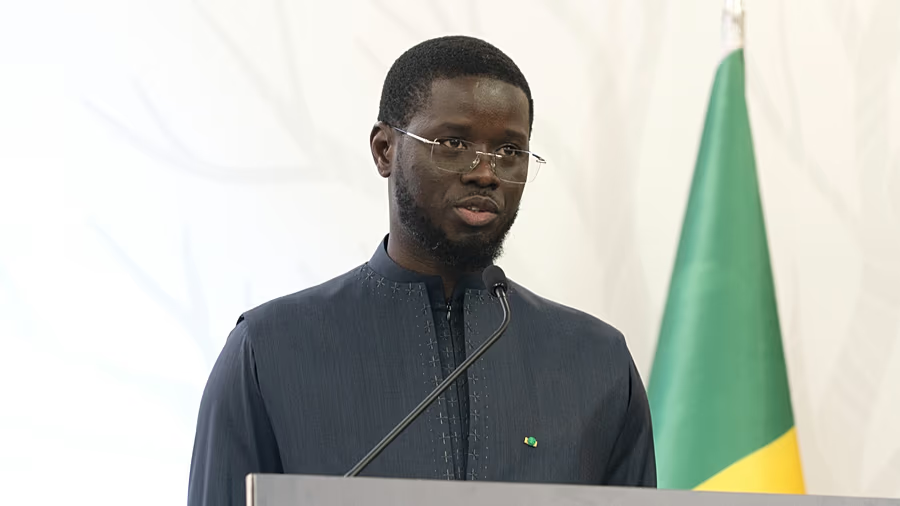
Finance Minister Cheikh Diba described the outcome as a "technical agreement that paves the way for financing prospects," but the government has not yet detailed exactly which structural measures it will implement to hit that target.
The Downside: What Senegal Gives Up For This Loan
An ECF-backed reform programme typically comes wrapped in fiscal consolidation targets, spending discipline, and structural benchmarks that constrain how freely a government can spend, even on politically popular programmes.
Senegal has already narrowed its fiscal deficit sharply, from 13.4% of GDP in 2024 to 6.4% in 2025, largely through spending rationalisation.
Sustaining that pace under IMF supervision over the next three years leaves little room for the kind of big-ticket social spending or subsidy relief that a young, fast-growing population may be pushing for.
There is also a market credibility cost. Even after the staff-level deal was announced, Senegal's sovereign bonds fell to record lows, an indication that investors are pricing in a debt restructuring.
Pursuing debt treatment through the G20 Common Framework, while necessary, can also mean prolonged negotiations with creditors and potential haircuts that affect Senegal's borrowing terms for years afterward.
Then there's the issue of sovereignty that keeps appearing in Dakar's politics. National Assembly Speaker Ousmane Sonko has demanded full transparency around the debt treatment plan and insisted parliament get to debate the terms, a sign that domestic political friction, not just external IMF conditions, could complicate how smoothly reforms get implemented.
Where The Real Gain Sits For Senegal
Despite the constraints, this deal is still cheaper than the alternative. Concessional IMF financing carries far lower interest rates than the regional bond market Senegal has been relying on since 2024.
Locking in a three-year ECF programme also signals to other lenders, bilateral partners, and ratings agencies that Senegal's finances are being independently monitored, which can gradually rebuild the market access that collapsed after the hidden-debt scandal.
There is also a growth story underpinning the deal. Senegal's economy expanded by 6.7% in 2025, its first full year of offshore oil production, and non-hydrocarbon growth rebounded to 4.7% year-on-year in the first quarter of 2026, largely driven by strong private consumption.
Inflation has stayed contained at 1.4%. An IMF-backed programme gives Senegal a framework to convert that growth momentum into debt sustainability rather than letting oil revenue get absorbed by ever-rising borrowing costs.
What Happens Next
The staff-level agreement is not a done deal. It still needs IMF Executive Board approval, financing assurances from Senegal's partners, and a resolution on the misreporting waiver.
Until those boxes are ticked, no disbursement happens. For Senegal, the $2.2 billion programme is one that trades short-term fiscal flexibility for a shot at cheaper financing and restored market trust.