Tanzania Post-Election Crackdown: Human Rights Crisis Deepens as Journalists Face Silencing
Tanzania plunged into a severe human rights crisis following its disputed October 2025 elections, marked by widespread protests, lethal government crackdowns, and credible reports of mass killings and body concealment. Amidst an internet blackout and intense media suppression, journalists and opposition figures faced arrests, treason charges, and even death. International human rights organizations are now urgently calling for independent investigations and accountability for the grave violations.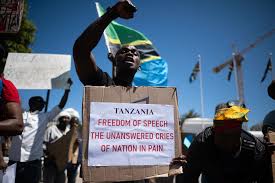
Tanzania witnessed a severe human rights crisis and political turmoil following the disputed presidential and legislative elections on October 29, 2025. President Samia Suluhu Hassan was declared the winner with 97.66% of the vote, a result immediately challenged by opponents and international observers who cited significant irregularities. The Southern African Development Community (SADC) Electoral Observation Mission (SEOM) concluded that the elections "fell short of the requirements of the SADC Principles and Guidelines Governing Democratic Elections," preventing voters from expressing their democratic will. Similarly, the African Union Election Observer Mission (AUEOM) noted non-compliance with AU principles and international standards.
The post-election period erupted in widespread protests across Tanzania, met with a brutal and lethal response from state authorities. Credible reports, including those from Human Rights Watch and the UN, indicate hundreds, potentially thousands, of people were killed by police and unidentified security personnel from October 29 to November 2, 2025. A senior doctor in Dar es Salaam corroborated chilling reports of body concealment, testifying to AFP that over 200 patients were "taken away while receiving treatment" by ununiformed men in "green trucks resembling military vehicles," and more than 300 bodies were removed from the morgue during a single shift. Family members attempting to claim bodies were reportedly threatened with arrest. Footage verified by the BBC and CNN showed bodies on streets and outside hospitals, with CNN suggesting security forces were linked to civilian killings and mass graves existed. The government has consistently refused to provide an official death toll or address allegations of mass graves, despite overwhelming evidence.
The crackdown extended to the media, with authorities imposing a five-day internet blackout during the unrest to prevent information from circulating. Journalists faced severe repression, including arrests, detention, and charges. Maneno Selanyika was killed near his home in Dar es Salaam on election day. Master Tindwa Mtopa, a sports journalist, was shot at his home, and Kelvin Lameck died in Mbeya while reportedly "on duty." While the Committee to Protect Journalists (CPJ) has yet to independently confirm if these deaths were work-related, it marks a significant escalation, with no fatal shooting of a Tanzanian journalist documented since 2012. Other journalists, like Kenyan reporter Shoka Juma, were arrested and accused of spying for reporting on border issues. Godfrey Thomas Ng'omba, an online news bureau chief, was charged with treason and conspiracy to obstruct elections alongside 55 co-defendants, though he was later released following a presidential directive to withdraw hundreds of charges. An unnamed broadcast reporter was found unconscious in a ditch after being arrested by military men, and Alphonse Kusaga, who runs Kusaga TV Online, was also arrested.
This climate of fear and repression led to widespread self-censorship within the Tanzanian media. Journalists and media owners expressed inability to publish critical stories, fearing treason charges—which carry the death penalty. Human rights lawyer Tito Magoti noted the media's absence in comprehensively covering the elections and subsequent atrocities due to state control and lack of "boldness." Efforts to control information flow began well before the elections, with President Hassan, despite an initial progressive stance in 2021, continuing to target online dissent, arrest journalists, and shut down critical outlets. Regulations were amended to filter "prohibited content," social media platforms like X were blocked, and online media outlets in Zanzibar were accused of operating without licenses or inciting hatred.
Beyond journalists, hundreds of Tanzanians, including children, were arbitrarily arrested and charged with offenses such as treason, incitement, and armed robbery. Among these was Tundu Lissu, leader of the main opposition party Chadema, who faced fabricated treason charges and was barred from the election, as was another opposition candidate. Human rights groups warned of "deepening repression" and "terror," highlighting abductions, killings, and torture of opposition officials and critics. The forced evictions of Maasai Indigenous communities from their ancestral lands in Ngorongoro district also drew concern.
International outcry has been significant. Over 20 civil society organizations, including AfricanDefenders, Amnesty International, Human Rights Watch, and CPJ, issued a joint letter urging the UN Human Rights Council to address the deteriorating situation. They called for a debate following a public briefing by the UN High Commissioner for Human Rights and potentially a special session. The High Commissioner himself called for prompt, impartial, and transparent investigations into the killings and violations. Western embassies issued a joint statement citing "credible reports" of extrajudicial killings, disappearances, arbitrary arrests, and concealment of bodies, demanding the release of bodies to families. However, President Hassan dismissed international criticism, blaming foreigners for protests and asserting that force used was not excessive. She announced a national commission of inquiry, but its mandate, composition—including former state officials and the Minister of Defence during the violence—and the President's public remarks questioning protestors' motives have led to its rejection by opposition parties and civil society as lacking independence and credibility.
The ongoing crisis, marked by a suffocating climate of fear and official denial, poses a significant risk to Tanzania's stability and its reputation as a beacon of peace in the region. Civil society groups emphasize the urgency of international action to ensure justice and accountability for severe human rights violations and prevent further deterioration, especially with protests planned for Independence Day on December 9.