Ruto's Broken Promises: Soaring Debt and A Crushing Budget Betray Hustlers
Kenya's fiscal landscape faces severe challenges as President William Ruto's administration struggles to curb debt, despite earlier pledges. The upcoming budget reveals a substantial deficit, prompting record domestic borrowing that analysts warn could "crowd out" the private sector. Concerns rise over a looming repayment crisis and stalled IMF talks.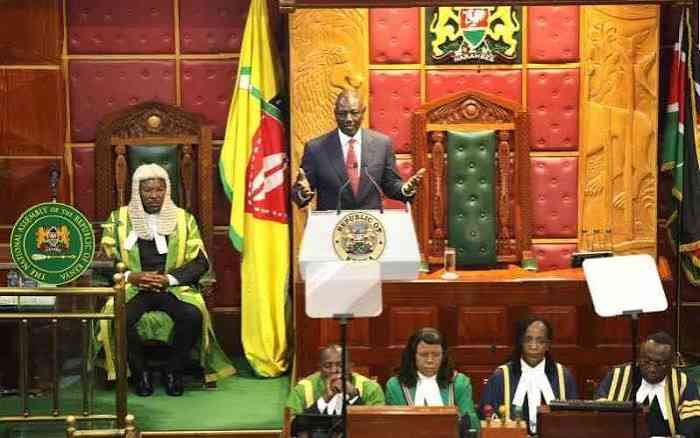
President William Ruto, upon being sworn into office in September 2022, made a significant promise to the Kenyan nation, vowing to end the cycle of debt. He declared that his government would never borrow to finance recurrent expenditure—the day-to-day spending on salaries, operations, and maintenance—and pledged to “bring ourselves back to sanity.” His ambition was to achieve a budget surplus within three years, ensuring that tax revenue would fully cover daily bills, and stated that borrowing beyond 10 percent was “unacceptable.”
However, 14 months into his first term, these initial pledges now appear to many analysts as a “eulogy for fiscal discipline.” The 2026-27 budget, presented by Treasury Cabinet Secretary John Mbadi on Thursday, is perceived as a testament to the very borrowing binge President Ruto had sworn to end. The government's plan involves spending Sh4.82 trillion in the fiscal year beginning July 1, while anticipating a revenue collection of only Sh3.63 trillion. This substantial discrepancy results in a staggering deficit of Sh1.146 trillion, equivalent to 5.5 percent of the Gross Domestic Product (GDP).
To bridge this considerable financial gap, the Treasury intends to borrow a record Sh1.03 trillion, primarily from local commercial banks, pension funds, and insurance companies, accounting for nearly 90 percent of the total financing. A smaller portion, Sh116 billion, is expected to come from foreign lenders. Official data from the Central Bank of Kenya (CBK) indicates that gross domestic debt reached Sh7.24 trillion as of May 15, having risen from Sh6.33 trillion in June 2025. When combined with an external debt of Sh5.78 billion, the nation's total public debt has climbed to approximately Sh12.84 trillion, inching close to the Sh13 trillion mark. Within just 27 months of taking office, by December 2024, the Ruto administration had already borrowed at least Sh1.4 trillion locally, which translates to roughly Sh2.5 billion every day.
The immense cost of servicing this escalating debt now consumes a significant portion of Kenya's ordinary revenue, nearing half of the total. In the forthcoming fiscal year, the government is set to allocate Sh1.5 trillion solely for debt repayments and pensions. This considerable sum diverts funds that could otherwise be invested in crucial public services such as hospitals, education, and infrastructure. The global audit and advisory firm KPMG, in its rapid assessment of the budget on June 12, issued a stark warning: “Kenya’s debt burden remains elevated, and the projected budget deficit continues to require significant financing. The planned domestic borrowing programme may crowd out private sector credit and place upward pressure on financing costs.” KPMG further highlighted that “continued reliance on domestic borrowing may place pressure on private sector liquidity and access to credit,” explaining that “crowding out” occurs when the government absorbs over a trillion shillings from local banks, leaving minimal funds available for small businesses, which are vital for job creation. This consequently leads to rising interest rates and stalled investment.
Adding to Kenya's fiscal challenges is the stalled dialogue with the International Monetary Fund (IMF). The Ruto government has resisted the global lender's demands for enhanced transparency concerning potentially “hidden” debt, including an estimated Sh684 billion in pending bills and securitised infrastructure loans. The Washington-based lender has explicitly stated that any new financing programme is contingent upon Kenya classifying securitised infrastructure funding as public debt and broadening its reporting to encompass all State entities. Government officials have privately acknowledged that their resistance has pushed potential discussions into 2027, which is an election year.
The Controller of Budget, Margaret Nyakang’o, has previously voiced serious concerns about a looming repayment crisis. During her parliamentary appearance in March, she cautioned that the government had entered a “vicious cycle” of expensive borrowing, wherein new loans are acquired merely to settle existing debts—a practice she termed “hazardous borrowing.” She disclosed that public debt had swollen to Sh12.29 trillion, representing 67.8 percent of GDP, and warned that Kenya faced the risk of defaulting on debts amounting to Sh3.32 trillion this year unless immediate fiscal reforms were implemented. Nyakang’o also noted that Sh1.59 trillion was consumed by debt service in the 2024-25 financial year, equivalent to 91 percent of the budget allocated for public debt, which she stated was “limiting cash flows and affecting the operations of business activities, especially Small and Medium Enterprises.”
The government's revenue generation problem is equally severe. Between July and March, the Kenya Revenue Authority (KRA) collected Sh84 billion less than its target, bringing in Sh2.038 trillion against a goal of Sh2.122 trillion, resulting in a performance rate of 96.1 percent. To achieve its full-year target of Sh2.97 trillion by June 30, KRA must collect an exceptionally high Sh932 billion in the final quarter, averaging Sh10.24 billion daily. Analysts largely consider this target to be almost unattainable, particularly given the subdued household purchasing power exacerbated by recent price hikes. A senior banker, speaking anonymously, commented, “The economy is slowing, demand is muted, and yet the government’s revenue needs are accelerating. That leaves only one option: borrow more. Every shilling lent to the government is a shilling not available for a small business to expand or hire workers. With elections approaching, this problem will only get worse.”
Commercial banks currently hold 36.1 percent of the government's domestic debt, according to CBK data. Economists warn that this concentration is “starving” the private sector of vital credit. Consequently, lending rates to businesses have surpassed 14.8 percent, even as the CBK's policy rate remains unchanged. Opposition leader Kalonzo Musyoka, in unveiling a counter-budget on Wednesday, criticized the government’s spending plan as “the largest in the history of the Republic of Kenya,” and characterized the nation's debt burden as “generational slavery.” President Ruto, who had initially promised to halt the accumulation of debt, is now perceived to have facilitated his Treasury chief in exacerbating the debt crisis.