Political Firestorm: Ghana's Chief Justice Under Scrutiny Over 'Unfortunate' State Institution Comments!
Ghana's Chief Justice faces calls for resignation from the NPP after making comments perceived as politically partisan and favorable to the current NDC government. Critics cite concerns over judicial independence, alleged 'two-speed justice,' and neglect of judicial infrastructure. While some defend his remarks, others emphasize ethical breaches given his official capacity.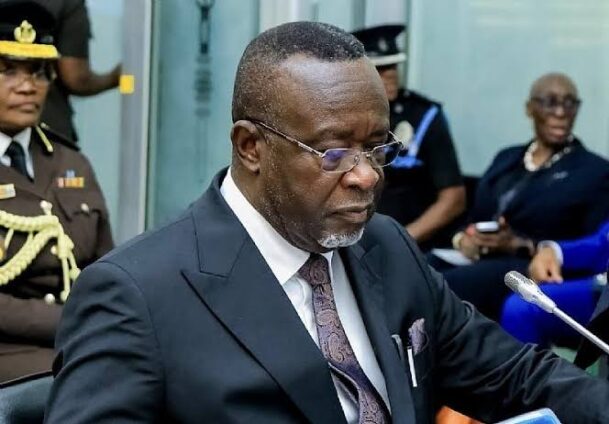
Ghana's Chief Justice, Paul Baffoe-Bonnie, has become the subject of intense controversy following remarks perceived as politically partisan, prompting the opposition New Patriotic Party (NPP) to demand his immediate resignation. The NPP accuses Justice Baffoe-Bonnie of compromising the Judiciary's independence and neutrality, asserting that his comments align him with the ruling National Democratic Congress (NDC).
The controversy stems from visits made by Justice Baffoe-Bonnie on Wednesday, September 2, to the Minerals Income Investment Fund (MIIF) and the Social Security and National Insurance Trust (SSNIT). During these engagements, he praised the performance of state institutions under the current NDC administration, openly questioning Ghana's actions over the previous eight years, a period that encompasses the former NPP government. He specifically referenced past plans to dispose of prized SSNIT assets like the Labadi Beach Hotel, expressing dismay at how "Ghana could have sunk so low." The NPP also alleged that the Chief Justice vowed that "everything must be done to ensure that the agenda of the President succeeds," a statement they found particularly alarming.
The NPP responded with "profound shock and disgust," labeling the Chief Justice's statements as "partisan political commentary" and "the language of a party propagandist," which they deemed entirely inappropriate for the head of Ghana's Judiciary. They argued that such remarks are inconsistent with the constitutional independence of the Judiciary, citing Articles 125 and 127 of the 1992 Constitution, which establish the Judiciary as an independent arm of government. The party also invoked the judicial oath, which mandates the Chief Justice to administer justice without "fear, favour, affection or ill will."
According to the NPP, these comments are not an isolated incident but rather the culmination of a pattern of conduct, alleging the Chief Justice has increasingly appeared at functions involving political appointees of the current government. This raised significant concerns about judicial neutrality, especially given the government’s Operation Recover All Loot (ORAL) initiative, under which persons associated with the NPP are being prosecuted. The NPP questioned how an accused person could expect impartiality when the head of the Judiciary pledges loyalty to the President's agenda, which includes initiatives like ORAL.
The NPP further accused Ghana's justice system of operating at "two speeds," alleging "remarkable haste" in cases involving government opponents while cases involving government allies proceed with "serene leisure." They cited the incarceration of their Ashanti Regional Chairman, Bernard Antwi Boasiako, popularly known as Chairman Wontumi, as evidence of selective justice. The party contended that this disparity reflects a coordinated effort between the Judiciary and the Executive to target political opponents and align the judicial machinery with the President’s agenda.
Beyond issues of political commentary, the NPP criticized the Chief Justice for allegedly neglecting the "deplorable state" of Ghana’s courtrooms and judicial infrastructure. They claimed numerous courts and judicial offices suffer from dilapidated conditions, overwhelmed registries, and staff working under challenging circumstances that impede effective justice delivery. The NPP accused him of failing to visit these ailing courts or advocate for their refurbishment, instead portraying him as a "monitoring and evaluation officer of the Executive," focused on external agencies rather than his own "collapsing house."
In response to these perceived transgressions, the NPP demanded an immediate and unreserved retraction of the Chief Justice's partisan commentary and alleged pledge of loyalty to the President’s agenda. Failing that, they insisted he should resign and formally join the NDC. The party also called on President John Dramani Mahama to fill a vacant Council of State position and publicly disavow any arrangement concerning the Chief Justice’s post-retirement future. The NPP announced plans to organize a major press conference to present the "full record" of the Chief Justice’s conduct, reiterating that the Judiciary belongs to the people of Ghana and must remain independent of political control.
Conversely, Franklin Cudjoe, President of IMANI Africa, defended the Chief Justice, dismissing claims of political motivation. Speaking on Joy FM's Middaynews, Cudjoe argued that "available data" supports the view that some state institutions are indeed performing better than they did under the previous administration. He questioned whether the Chief Justice had breached any specific law or stated anything untrue, asserting that there was "nothing inherently wrong" with commenting on public matters during an official engagement, especially when responding to a presentation on institutional performance.
However, Nana Adjei Baffour Awuah, Manhyia South MP and a member of Parliament’s Constitutional and Legal Affairs Committee, echoed concerns about compromised neutrality, describing the Chief Justice's comments as an "unfortunate indiscretion" and "extremely unfortunate." He emphasized that while no specific law might have been breached, the remarks raised serious ethical concerns. Awuah highlighted the Chief Justice's official capacity, noting he attended the events in "official regalia" and was accompanied by other Supreme Court judges and judicial officials, thereby imbuing his comments with the "full institutional weight of the Judiciary." He stressed that the Judiciary must maintain strict neutrality when commenting on political administration.
As of the time of publication, neither the Chief Justice nor the Judicial Service had publicly responded to any of the allegations made by the NPP or other critics, leaving the accusations of compromised judicial neutrality and integrity unresolved.