Nation Gripped by Fury: NLC Unleashes Mass Protest Over Soaring Insecurity
Nigerian labour unions and civil society groups staged nationwide protests on Wednesday, demanding urgent government action to address alarming levels of insecurity and deteriorating economic conditions. Despite last-minute talks with President Bola Tinubu, the Nigeria Labour Congress and its allies proceeded with demonstrations across Abuja, Lagos, and Osun State, highlighting a surge in kidnappings, killings, and the impact of the cost of living crisis on citizens.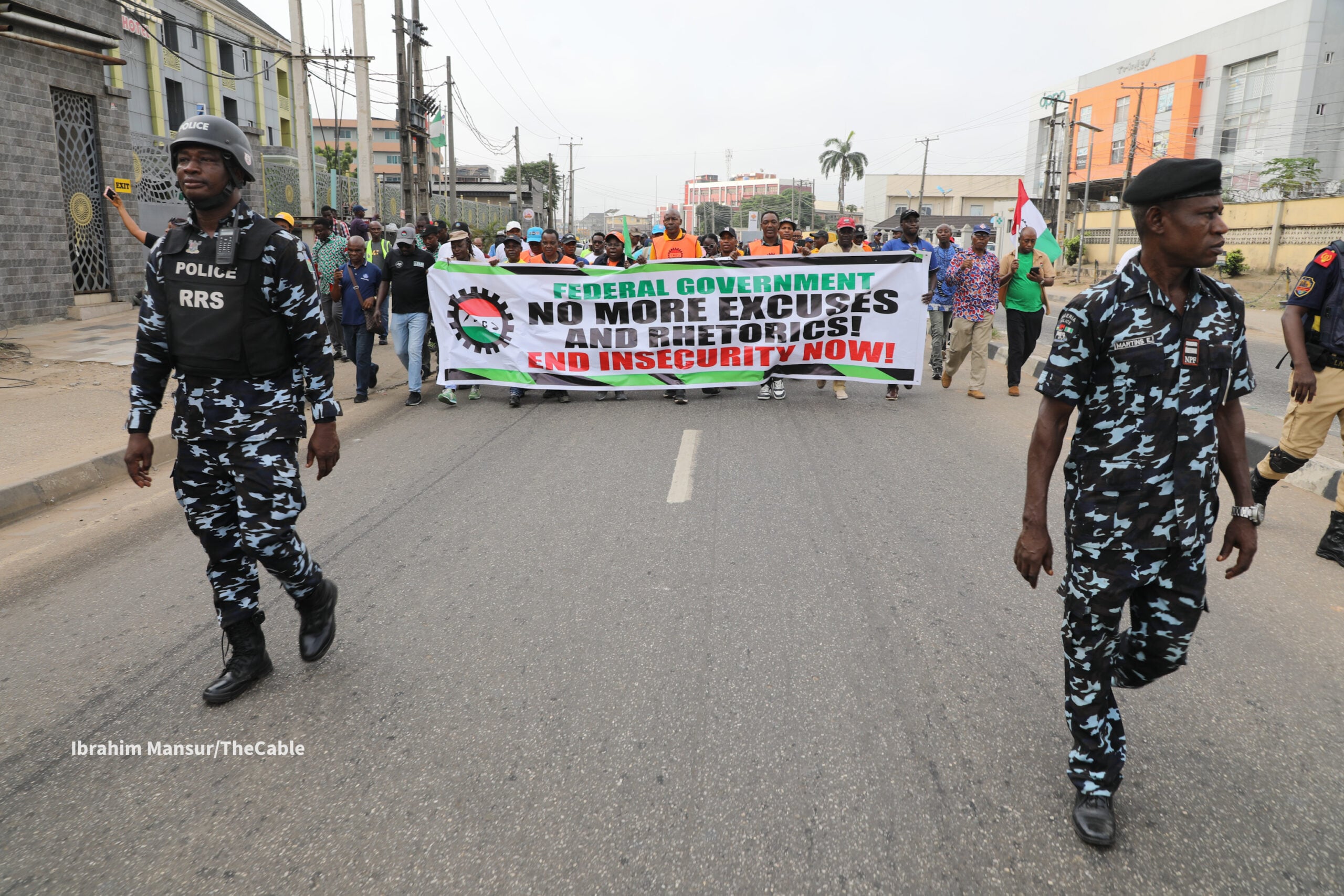
The Nigeria Labour Congress (NLC) and its allies embarked on a nationwide protest on Wednesday, advocating against the worsening state of insecurity and deteriorating economic conditions across the country. This widespread demonstration proceeded despite last-minute efforts by President Bola Tinubu's administration to avert the action through discussions with NLC leadership.
The protests, which saw members of the NLC, along with civil society activists and various other unions, converge in major cities like Abuja, Lagos, and Osun State, were prompted by an alarming surge in violent crimes, including mass abductions and killings, coupled with a severe cost of living crisis and unresolved labour grievances. The NLC's National Executive Council (NEC) had initially announced the action following a meeting on December 4, with a notice circulated to state chapters on December 10, emphasizing the peaceful and lawful nature of the demonstrations.
In Abuja, NLC President Joe Ajaero led the protest from the Labour House, joined by prominent civil society figures such as Omoyele Sowore of the Revolution Now Movement. The demonstration also saw participation from members of the Joint Health Sector Unions, Nigerian Union of Teachers, and the National Union of Electricity Employees. During the protest, an NLC member voiced strong anger over the prevalence of violent crimes, advocating for capital punishment for kidnappers. Achike Chude, National Secretary of the NLC, addressed protesters, asserting that the country was "at the verge of collapse" due to insecurity and financial strain on citizens, urging the government to act decisively.
Similar scenes unfolded in Lagos, where NLC members gathered at the Ikeja underbridge before marching to the Lagos House of Assembly, chanting solidarity songs condemning the federal government's inability to protect lives and property. Human rights lawyer Femi Falana also joined the protest in Lagos, lending his support to the workers' demands.
In Osun State, the protest was particularly robust, with the NLC joined by the National Association of Nigerian Students (NANS), Trade Union Congress (TUC), Non-Academic Staff Union of Educational and Associated Institutions (NASU), and the Nigeria Union of Journalists (NUJ). Protesters converged at the popular Olaiya Flyover in Osogbo, temporarily shutting it down and causing traffic snarls. Placards bearing inscriptions like “Poverty Fuels Insecurity,” “FG, We Need Actions, Not Excuses,” and “Tinubu, Act Now. Stop the Criminality, Save Jobs, Pay Local Government Contractors,” clearly articulated their frustrations. Osun NLC Chairman, Christopher Arapasopo, called on federal and sub-national governments to protect citizens, lamenting the continuous rise in killings and abductions.
The decision to proceed with the protest came after Tuesday night talks between President Tinubu and NLC leadership failed to yield a resolution. NLC President Joe Ajaero confirmed that the engagement did not address the union's concerns. In Osun, Chairman Arapasopo questioned the timing of the government's invitation for talks, highlighting that the protest had been announced weeks in advance, suggesting a lack of genuine effort to engage earlier. He also clarified that the national NLC leadership was invited by the Forum of State Governors, not directly by the President, hours before the protest.
Beyond the immediate security crisis, the NLC also highlighted broader grievances. The union cited the abduction of 24 schoolgirls in Kebbi State on November 17, during which two staff members were killed, condemning what it described as the withdrawal of security personnel before the attack. The NLC communiqué stressed that "The surge in kidnappings targeting schoolchildren has reached an alarming and unacceptable level." Furthermore, the demonstration addressed the impact of insecurity on workers' safety, productivity, and livelihoods, noting that teachers, farmers, and miners have been among those killed or displaced. The economic dimension of insecurity was also a key focus, with protesters demanding that the minimum wage be commensurate with the high cost of living.
Waheed Lawal, Chairman of the Osun State Coalition of Civil Societies, urged President Tinubu and state governors to resign if they could not effectively tackle insecurity. He highlighted economic insecurity, stating that N70,000 as a minimum wage is insufficient. Lawal also raised concerns about the infiltration of criminals in Osun State, citing the recent abduction of a former Customs officer and the killing of a village chief in the Ora community. He called on Governor Ademola Adeleke to ensure the reopening of two shut Amotekun offices and resolve issues surrounding detained Amotekun operatives. Farouk Sodiq, a student leader, echoed these demands, emphasizing that "students are no longer safe."
Throughout the protests, police officers were deployed to locations in Abuja and Lagos. The NLC had formally notified security agencies in advance, urging them to protect citizens exercising their constitutional right to peaceful assembly, declaring, "Solidarity is our shield."