MTN's Tax Shock: Ghana Takes Heavier Toll Than Nigeria!
MTN Group reported a significant increase in tax payments to African governments in 2025, totaling R61.11 billion, driven by surging profits and revenue. Despite Nigeria being the most profitable market, Ghana emerged as the highest tax contributor, a disparity explained by differing tax regimes, mobile money growth, higher profit per subscriber, and exchange rate stability.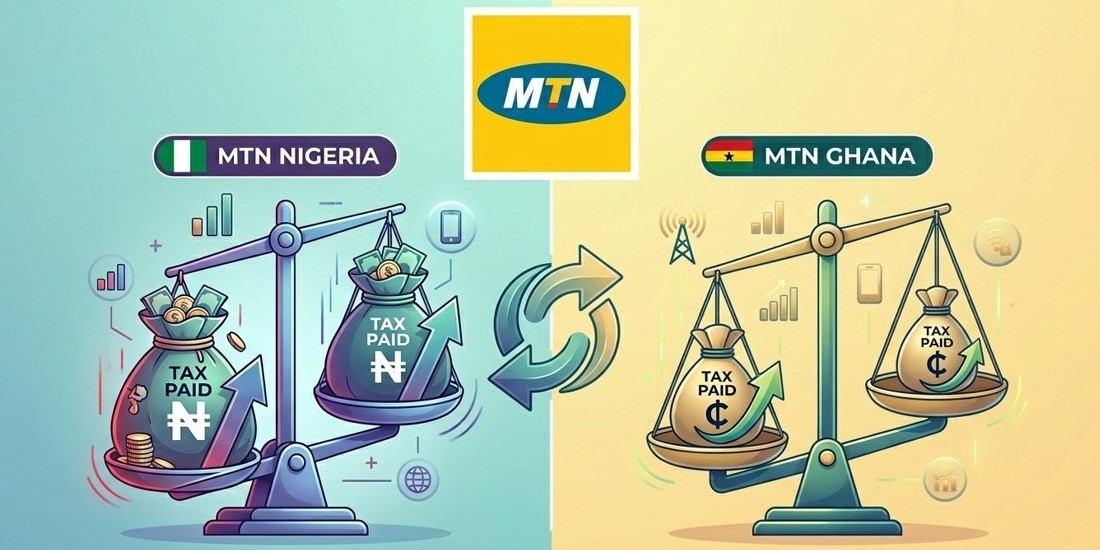
MTN Group announced in its 2025 tax transparency report (TTR) that it paid R61.11 billion in taxes to African governments during the year, marking a nearly 16% increase from the R52.7 billion paid across its 16 markets in 2024. This significant rise in tax contributions is attributed to a robust financial performance, as the telecom giant bounced back from a R4.1 billion loss in 2024 to record a profit before tax of R47.7 billion. Consequently, its profit tax climbed from R10.8 billion to R12.2 billion. Total revenue for the period also saw a sharp increase, reaching R226.8 billion, up from R188 billion in 2024, primarily driven by strong data revenue performance in its Nigerian and Ghanaian markets.
Geographically, the West and Central Africa (WECA) markets contributed the largest share of the tax amount, accounting for 52.3%, while the Southern and East Africa (SEA) region represented 19.87% of the total. On a market-specific basis, Ghana emerged as the leading contributor, with MTN paying R16.95 billion there, representing 27.75% of the total tax. Nigeria followed with R10.52 billion, a 17.22% share, ahead of Uganda (R8 billion), Cote D’Ivoire (R6.5 billion), and South Africa (R4.81 billion).
An analysis of tax types reveals that indirect taxes constituted the largest share at 32.2%, followed by corporate tax (10.4%), operating license fees and levies (8.5%), withholding taxes (4.2%), payroll tax (3.8%), and dividends tax (1.8%).
Despite Nigeria being MTN Group’s most profitable market, contributing 28.9% to service revenue in 2025 and achieving a significant profit after tax of N1.1 trillion (a 377.9% surge from a N400.4 billion loss in 2024), MTN paid substantially more tax in Ghana. Nigeria also boasts the group's largest subscriber base, ending 2025 with 87.3 million users. In contrast, Ghana's net income climbed over 50% in 2025, with profit after tax surging by 55.9% to $731 million (₵7.8 billion), and earnings per share increasing by 55.9%.
The discrepancy in tax payments between Ghana and Nigeria, where Ghana paid R16.9 billion in tax compared to Nigeria’s R10.5 billion (equivalent to ₵11.49 billion and ₦1.43 trillion for Ghana, and ₵7.14 billion and ₦886.7 billion for Nigeria in local currencies, respectively), can be attributed to several factors. Firstly, government policies and tax regimes differ significantly. Ghana's tax structure, unlike Nigeria's, is designed to capture a higher proportion of indirect taxes, including VAT, regulatory levies, customs duties, specific telecom industry taxes, and mobile money-related charges. Ghana imposes a stricter overall tax burden on its telecom operators, with higher structural tax and VAT rates on the industry, necessitating a larger percentage of MTN Ghana’s revenue to be paid as tax. The substantial growth of mobile money in Ghana, which scaled by 35.7% to ₵6.0 billion with active users growing by 12.3% to 19.3 million in 2025, further boosts its total tax contribution.
Secondly, a closer examination reveals that MTN Ghana generates more profit per customer than MTN Nigeria. In Rand terms, Ghana contributed R11.47 billion to the group’s profit, while Nigeria contributed R13.03 billion. However, on a profit-per-subscriber basis, Ghana led with R367.6 (₦31,087) compared to Nigeria's R149.3 (₦12,579). MTN's revenue per customer in Ghana is 2.47 times higher than that of Nigeria, indicating a higher profitability in real terms, irrespective of market size. Lastly, exchange rate movements played a role; the Nigerian naira experienced volatility in 2025, while the Ghanaian cedi remained more stable. These currency fluctuations are crucial as they influence how each market’s tax payment translates when compared in the group’s Rand-calculating terms.
This analysis underscores that revenue and profit figures alone do not solely determine tax payments. Instead, country-specific policies, profitability on a per-subscriber basis, and exchange rate movements are critical factors influencing the total tax contributions of multinational corporations like MTN Group.