In the Month We Talk About Men's Mental Health, Who Is Talking to African Men
Men’s Mental Health Month happens every year in June, but for many African men, vulnerability was never a language they were taught. Masculinity, patriarchy, silence, and what the numbers reveal about men who hold everything in.
What does he do? Where does he work? What car does he drive? How much does he earn?
Those four questions follow a man from the moment he becomes old enough to be evaluated, and in many African homes, that age arrives shockingly early. Before a boy learns to shave, the world has already handed him a scorecard.
Strength, provision, silence, endurance. These are the categories. These are what he will spend the rest of his life being graded on. Nobody adds a column for how he is doing inside.
June is Men's Mental Health Month. It happens every year with good intentions, campaigns, hashtags, carefully worded posts about speaking up. But the man it is trying to reach is the same man who was taught, sometimes without a single spoken word, that speaking up is the one thing real men do not do. Most men get that lesson before they get any other.
Here is what rarely gets said: he was not born like this. Something was done to him.
The Weight They Were Handed at the Door
An African boy is born free. Then, as he grows, so do his chains, and everyone around him calls those chains manhood. Do not cry in public. Do not hug your fellow man. Do not carry an umbrella in the rain; take the rain. Do not admit you are struggling, because struggling is the default, and naming it changes nothing except the way people look at you.
The toxic effect of patriarchy on boys who grow up to become men is one of the most underdiscussed wounds in African society. Many are born and, almost immediately, denied access to the full range of being human.
The tenderness, the fear, the grief, the need for comfort, all of it gets surgically removed by a culture that mistakes emotional suppression for strength. These are not random preferences. They are a curriculum, taught by men who were taught by men who also had no language for what they felt.
The cycle does not self-correct. It replicates, a father who was told to be stone raises a son who becomes stone, and both live and die without ever once being asked the most basic human question: how are you, actually?
Research published in the journal Heliyon confirms that masculine norms in African societies are a significant driver of what researchers call "restrictive emotionality" — men conditioned to be unable to identify, express, or even locate their own feelings.
This is not weakness, it is subtle engineering through traditions, patterns, and what is taught intentionally over the years.
And then that same society turns every June and says: speak up, you are not alone. The man who needed to hear that most has already learned not to trust it.
The Numbers Say What the Men Cannot
Globally, men account for nearly 80% of all deaths by suicide, according to data from the CDC and the American Association of Suicidology. In sub-Saharan Africa, the male suicide rate stands at 18 per 100,000, considerably above the global average of 12.4 per 100,000, according to a 2025 BMC Psychology study on masculinity and mental health in African communities.
In South Africa alone, approximately 79% of all mental health-related deaths recorded in 2019 were men. These are not statistics about weakness. They are statistics about silence.
Social Insight
Navigate the Rhythms of African Communities
Bold Conversations. Real Impact. True Narratives.
In the United States, only 35% of men sought mental health care in the year before dying by suicide. The Crisis Text Line reported in 2025 that fewer than 20% of people reaching out identified as male, from an organisation receiving over 1.5 million messages annually.
Now pair those numbers with the reality many African men navigate daily: economies where job security is fragile, where being the provider is not aspirational but mandatory, where failure to provide is not just personal; it is a verdict on your worth as a man. There is no room in that framework for anxiety.
There is no room in that framework for anxiety, no room for insecurity. Certainly no room for fear of failure, even when fear of failure is rational and completely human.
Some men are not struggling with existential crises. They just want a stable income and one good night of sleep without the weight of everyone depending on them pressing down on their chest.
That is the version of men's mental health nobody photographs for the awareness campaign, the ordinary man, grinding quietly, not glamorously broken, just tired in a way that does not have a hashtag.
Seen, Finally — Even If Barely
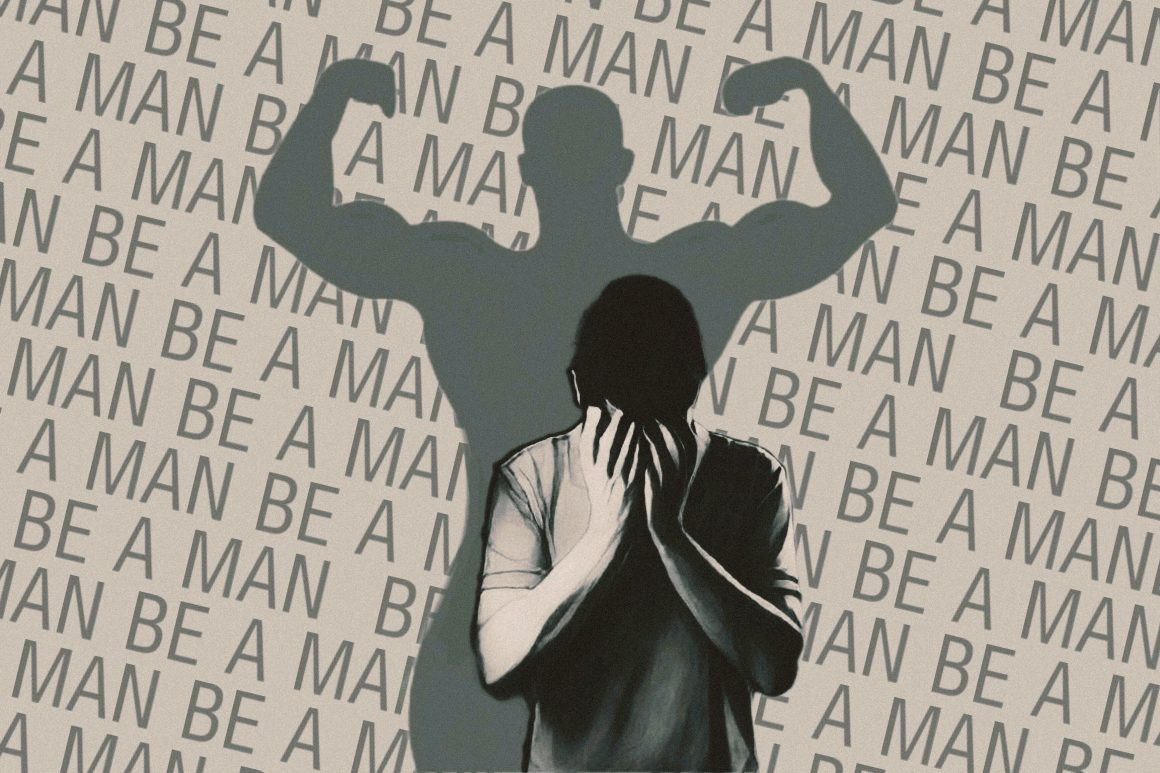

There is a particular cruelty in the way African men are simultaneously stereotyped and unseen. Public discourse loads them with the worst of what men do, violence, abandonment, emotional unavailability, as though these behaviours emerged from personality rather than from a conditioning that began in childhood, but that is not to dismiss the behaviour of some of them.
The same discourse has almost no vocabulary for what African men carry privately: the specific grief of a man who tried, came up short, and has no one to tell.
In isiZulu, there is not even a word for depression, not merely absent from conversation, absent from the language itself. That is how deep the architecture of denial goes, not a cultural oversight, but a cultural design that has made certain emotions literally unspeakable.
Yet men are changing, slowly, unevenly, without public acknowledgement. Men who speak in hushed tones to a friend about anxiety because it is the closest they can get to admitting it.
Men who sit in cars outside the house for twenty minutes because they need a moment between the chaos outside and the performance of stability expected indoors. These men are not broken. They are trying, quietly, against an architecture that was never designed to help them.
This is what Men's Mental Health Month is for, not the men who already have the language. For the man who does not know yet that exhaustion is not a personality trait. That anxiety is not a character flaw. That needing help is not the opposite of being a man. It is one of the most honest things a man can be.
Let that man be. Let him grow. Let him feel what he was always supposed to feel, without an apology, without an audience, and without the weight of a script he never agreed to perform.
The strongest thing an African man can do right now is say: I am not okay, and mean it without apology.
M