Historic Victory: Pro-EU Party Claims Decisive Election Win in Armenia
The Armenian parliamentary elections on June 7, 2026, saw Prime Minister Nikol Pashinyan's Civil Contract party secure a strong mandate for a pro-West future, amidst declining Russian influence. Pashinyan pledged a balanced foreign policy, peace with Azerbaijan, and domestic reforms, while facing accusations of electoral violations and democratic backsliding from the opposition.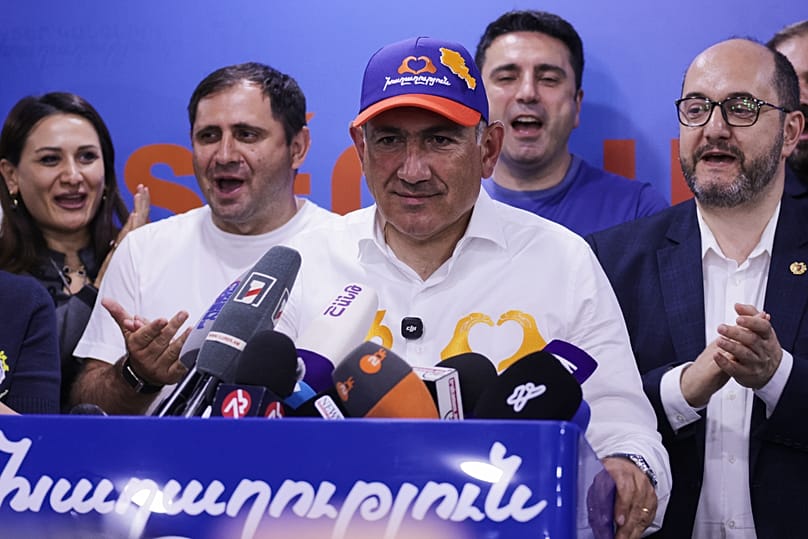
Armenians have decisively chosen a path towards a balanced, pro-West future, granting incumbent Prime Minister Nikol Pashinyan's Civil Contract party a strong mandate following parliamentary elections on Sunday, June 7, 2026. Early results, reported on Monday, June 8, 2026, indicated his party's significant lead, signaling a potential shift in regional influence away from Russia, despite Moscow's reported threats and alleged interference.
With over 60% of the votes tallied, the Central Election Commission announced that the Civil Contract party secured 51.2% of the vote. Russian-Armenian billionaire Samvel Karapetyan's Strong Armenia alliance came in second with 23%. Additionally, two other opposition forces, ex-president Robert Kocharyan's "Armenia" alliance and the Prosperous Armenia party, surpassed the electoral threshold, achieving 9.9% and 4.1% respectively. The overall voter turnout was recorded at 59%.
Speaking from his party headquarters, Prime Minister Pashinyan hailed his party's "historic victory," stating it would "ensure Armenia's eternity and development." He pledged to continue a course of "rapprochement with the West" while simultaneously developing Armenia's relations with Russia, emphasizing a balanced foreign policy. Pashinyan also expressed hope for a positive response from Turkey and Azerbaijan regarding regional prosperity and cooperation, advocating for the "institutionalisation of peace between Armenia and Azerbaijan." Domestically, he vowed "the final eradication of the criminal-oligarchic system from Armenia," asserting that "the leaders of these forces must be held criminally liable."
This election follows years of political upheaval since Pashinyan's rise to power through a 2018 street revolution. The 51-year-old Prime Minister has actively sought to reduce Armenia's reliance on Moscow, particularly after Russia's perceived failure to offer adequate support during the Karabakh conflict. While the United States, through President Donald Trump, offered "TOTAL Endorsement for Re-Election" to Pashinyan, Moscow has expressed concerns over the potential loss of another ally in its sphere of influence. Russia had previously compared Armenia's ambitions to join the European Union to one of the justifications for its 2022 full-scale invasion of Ukraine.
The Kremlin was accused of attempting to influence the vote, with analysts noting the spread of misinformation, hacker activity, and pro-Kremlin narratives portraying Western cooperation as hazardous. Weeks prior to the election, Russia banned imports of several Armenian products, a move widely interpreted as an attempt to exert economic pressure. Armenian officials themselves warned of "enemies of freedom" funding propaganda efforts.
The campaign itself was a fierce contest over Armenia's geopolitical future. Pashinyan warned voters of a potential "catastrophic war" with Azerbaijan within months if his party failed to secure a strong majority, a rhetoric his opponents labeled as fear-mongering. Opposition parties, in turn, accused authorities of electoral violations and repression, leading Armenia's Investigative Committee to open 59 criminal cases and detain nine individuals over alleged infringements, including multiple voting. Strong Armenia's leader, Samvel Karapetyan, who was under house arrest on coup plotting charges he denies, rejected claims of pulling Armenia back into Russia's orbit but cautioned against Pashinyan's "reckless rush" to the West.
Pashinyan's democratic record was also scrutinized, with increasing accusations of democratic backsliding eight years after he promised to dismantle the oligarchic system. However, for many Armenians, the opposition remained linked with Russian influence and oligarchic structures. Voter Hakob Hakobyan, 63, expressed, "I voted for peace. Only Pashinyan can bring peace." Conversely, Khachatur Movsisyan, 59, supported an opposition party, believing "the country, and all of us, need change, in foreign policy, domestic policy and in negotiations with Azerbaijan." The significance of these elections was highlighted by international media, with reports, such as Euronews' live coverage from Yerevan, underscoring the global interest in Armenia's political trajectory.