He Hijacked a Plane, Took $200,000, and Disappeared: The D.B. Cooper Mystery
The D.B Cooper mystery; remains one of the most intriguing stories to ever be told. And to date, little pieces of evidence keep popping up to keep the legend alive.
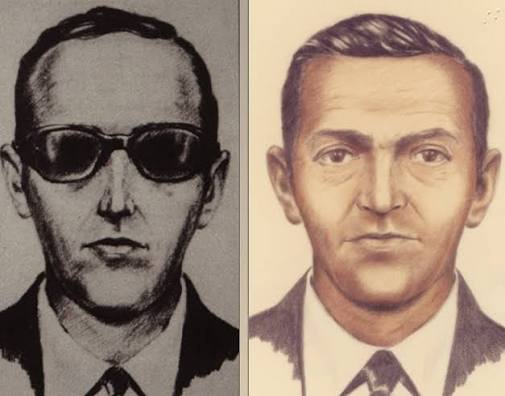
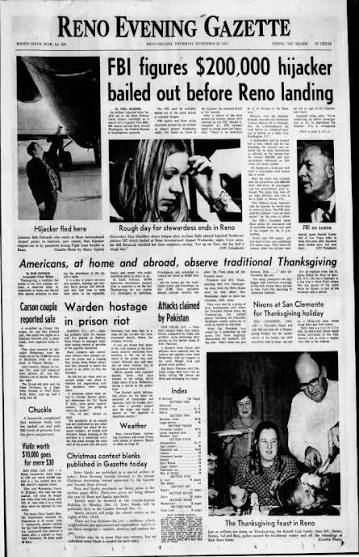
In what might be one of the most mysterious cases in United States criminal history, an unknown man using the alias Dan Cooper hijacked a Boeing 727 on Northwest Orient Airlines Flight 305, en route from Portland to Seattle on November 24, 1971, just a day before Thanksgiving.
According to credible sources, this case remains the FBI’s only unsolved hijacking in the history of commercial aviation.
THE HIJACKING
On the eve of thanksgiving, a nondescript man who appeared to be in his 40s and about 6 feet tall bought a $20 ticket for Northwest Orient Airlines Flight 305. He gave his name as Dan Cooper, which was later discovered to be an alias. According to reputable reports, Cooper was a quiet man and unassuming man who wore a business suit with a black tie and white shirt and while waiting for takeoff, he ordered a drink.
Shortly after take off from Portland at about 3:00 pm, he handed to a flight attendant a note that indicated that he had a bomb in his briefcase and asked that she sit next to him. When she did, Cooper gave her a glimpse of what was supposedly inside the briefcase, and according to her testimony she saw a mass of wires and red coloured sticks.
Cooper requested she wrote down on a piece of paper what happened to be his demands, and soon she was taking a note that demanded $200,000 in twenty dollar bills and four parachutes.
Upon landing in Seattle, Cooper executed a carefully planned exchange. He released the 36 passengers in return for his demands but kept crew members which included 2 pilots, a flight engineer and a flight attendant in the plane.
After refuelling, the plane took off again, this time bound for Mexico City. However, somewhere over southwestern Washington, just after 8:00 p.m., Cooper did the unthinkable — he lowered the rear stairs of the Boeing 727 and parachuted into the night with the ransom money beginning one of the most elusive man hunt ever.
THE INVESTIGATION AND MANHUNT
And with that hijacking, came the never ending hunt of the man responsible. The FBi Who learned of the crime in flight immediately opened an extensive investigation named NORJAK — that is the Northwest Hijacking and this lasted for many years.
The NORJAK tracked leads across the nation, interviewed hundreds of people and scoured the plane for evidence. Items left behind by the hijacker included cigarette buts, a hair strand, and a clip-on tie but no usable fingerprints were recovered.
5 years in, and the investigative unit reported they had considered up to 800 suspects and eliminated all but two dozen from the list of suspects.
History
Rewind the Stories that Made Africa, Africa
A Journey Through Time, Narrated with Insight.
Theodore Braden, a special forces commander during the Vietnam war, also a master sky diver and convicted felon made the list of suspects. He was believed by many especially those within the special forces community both after the hijacking and during subsequent years to have been Cooper.
Braden was described by fellow special forces veterans in the October 1967 issue of Ramparts magazine, as someone with a secret death wish, this reinforcing the fact that he wouldn't have thought twice about pulling off that Cooper flight into the night.
In regards to his appearance compared to Cooper, witnessed believed all his features with the exception of heights were in line with that of Cooper. Braden was eventually sent to Federal prison during the late 1980s, serving time in Pennsylvania, but the precise crime is unknown.
Kenneth Christian was also another name that came up on the list. Though deceased, Kenneth made the list when his brother Lyle upon watching a documentary became convinced that his brother was Cooper. Kenneth displayed similar behaviours as did Cooper during the hijacking — a fondness for bourbon as well as smoking and Stewardess Florence Schaffner reported then that Kenneth did match the appearance of Cooper though she couldn't conclusively decide it was him.
Other names that made the list were Jack Coffelt, Lynn Cooper, Barbara Dayton, William Gossett, Joe Lakich, John List, Ted Mayfield, Sheridan Peterson, Robert Rackstraw among a long list of others.

But another name stood out again, and further evidence later discovered would suggest the same — this was Richard McCoy Jr.
On April 7, 1972, a man traveling under a fake name boarded a Newark-Los Angeles flight. Shortly after take off, he handed a note demanding $500,000 and four parachutes to a flight attendant and assured that he would take down the plane and everyone in it with a bomb if his needs weren't met.
The 727 landed and refueled and he carefully exchanged passengers for his demands before taking off to another destination when he jumped off the rear exit mid-flight. This event does sound familiar, right?
This hijacking which happened less than 5 months after the D.B. Cooper incident led many to believe the same culprit was responsible for both crimes.
The perpetrator of the April crime, Richard McCoy, Jr., was convicted of air piracy and received a 45-year prison sentence. On August 10, 1974, however, he and some fellow inmates hijacked a garbage truck and escaped their Pennsylvania penitentiary. When the FBI finally tracked McCoy down in Virginia three months later, a shoot-out left him dead.
FINDING THE MONEY
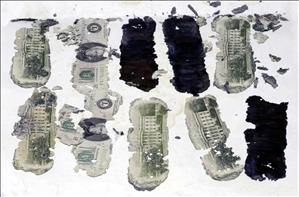
After many years of chasing dead ends, everything changed when 8-year old Brian Ingram who had been on vacation with family unearthed three crumbling bill packets which were turned over to the FBI, and the agency identified the bills by the serial numbers that had been supplied the night of the hijacking by Seattle First National Bank.
The assistant special agent in charge of the Portland FBI office, Bill Baker, said it was the first clue the FBI had since the night of the hijacking. And this led to more investigations and more bills were discovered just 5 feets from where young Graham had dug his. However, most of the bills were so deteriorated they were considered unreadable.
History
Rewind the Stories that Made Africa, Africa
A Journey Through Time, Narrated with Insight.
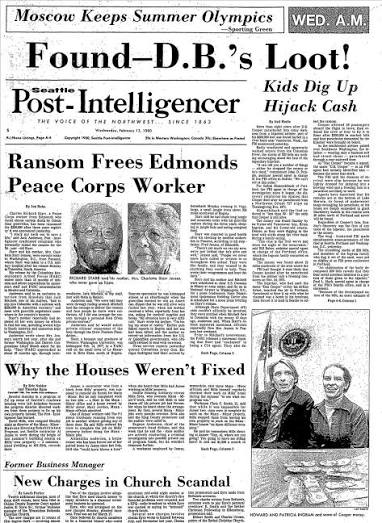
Theories quickly emerged to explain how the money ended up there. FBI agents and hydrologists suggested the bills may have washed downstream from the Washougal river, over time. Some believed the ransom may have intentionally buried the money near the river, while others believed the money had dropped from him during his daring parachute escape. Eventually the case went cold, with many more dead ends that kept being chased for decades.
Finally, on July 11, 2016, the FBI officially closed down NORJACK stating that it had been the most exhaustive and elusive manhunt in the bureau's history and resources were better redirected to other priorities.
THE 2023 REVELATION
Decades after the 1971 hijacking, new developments rekindled interest in the case. In 2023, the children of Richard McCoy — the convicted felon that was responsible for the April Hijacking that happened 5 months later, came forward with potential evidence.
They presented the FBI with a parachute and harness along with a logbook that had allegedly placed their father near the site of the hijacking.
The McCoy children stated they had waited until their mother passed away before sharing the items, believing the evidence could finally shed light on the mystery that had persisted for over 50 years.
While the FBI officially closed the case in 2016, these revelations suggest that the true identity of D.B. Cooper may finally be within reach. Despite the passage of time, the Cooper hijacking remains one of the most fascinating and enduring mysteries in American criminal history.