Guinea-Bissau in Turmoil: Ousted President's Exile Confirmed Amid Coup Fallout
A new GLOSARGG analysis attributes the Guinea-Bissau coup to constitutional violations, institutional decay, and criminal infiltration, as detailed by security expert Francis Ahovi. The report urges decisive regional and international action, outlining immediate priorities and comprehensive short, medium, and long-term reforms to restore stability.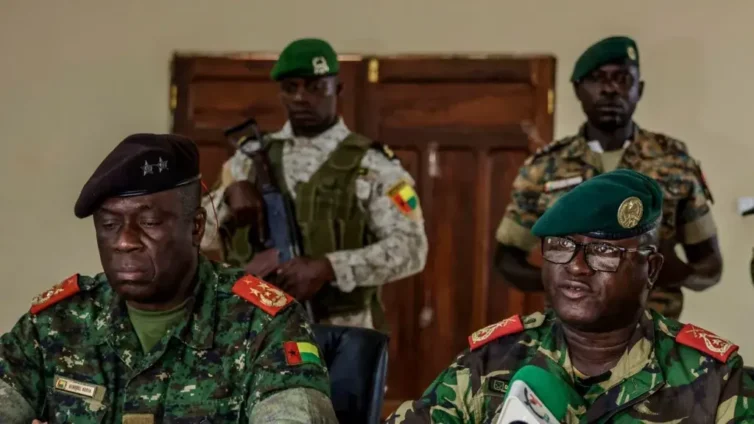
A recent analysis by the Global Security for Africa Research and Good Governance (GLOSARGG) has identified a confluence of constitutional violations, institutional decay, and profound criminal infiltration as the root causes of the latest coup in Guinea-Bissau. Francis Ahovi, GLOSARGG's Executive Secretary and a notable security expert, released this comprehensive assessment in a press statement on November 27th, 2025, urging both regional and international bodies to take decisive action to restore stability in the beleaguered nation.
Mr. Ahovi detailed how the ongoing crisis is a direct consequence of a sustained erosion of constitutional order. He pointed to repeated unlawful dissolutions of parliament, the unilateral dismissal and appointment of prime ministers by the executive, significant interference in the judiciary, and the systematic politicization of the security forces. These actions, according to Ahovi, have collectively engineered a perilous “governance vacuum” that has emboldened military factions and facilitated the rise of criminal actors, ultimately culminating in the overthrow of constitutional authority.
GLOSARGG's analysis further delineates multiple interconnected factors driving instability within Guinea-Bissau. These critical issues encompass executive overreach, fragmented command structures within both the military and police, the escalating influence of narcotrafficking networks, insufficient parliamentary oversight, and pervasive economic hardship affecting the populace. Francis Ahovi specifically highlighted how organized crime, particularly the lucrative narcotics trade, has deeply permeated political circles, exerting undue influence on high-level decision-making processes.
The assessment was also critical of the regional response to the crisis, pinpointing inherent weaknesses within key organizations such as ECOWAS and the African Union. Ahovi underscored issues like slow consensus-building among member states, a discernible reluctance to sanction sitting presidents who flout constitutional norms, limited rapid-deployment capabilities for intervention, and significant gaps in intelligence-sharing. He cautioned that inconsistent enforcement of sanctions has further eroded the credibility of regional efforts to maintain peace and stability.
To counteract the escalating crisis, GLOSARGG outlined several immediate priorities. These include the deployment of neutral observers to ensure the safety and protection of civilians, the implementation of targeted sanctions such as travel bans and asset freezes against key individuals, and urgent measures to stabilize the security forces by halting politically motivated promotions. Furthermore, the organization called for an independent fact-finding mission, to be jointly undertaken by ECOWAS, the AU, and the UN, with the mandate to meticulously document constitutional breaches and human rights violations.
Looking to the future, GLOSARGG proposed a short-term transitional arrangement, envisioned to last between six to twelve months. This period would be overseen by a civilian authority and fortified by a robust Security Oversight Mechanism designed to prevent further factional clashes. The plan also incorporates intensified anti-narcotics operations, to be conducted in collaboration with UNODC and EU partners, alongside scaled-up humanitarian assistance initiatives aimed at supporting vulnerable and displaced populations.
Medium-term reforms, spanning a timeframe of six to 24 months, are also detailed. These comprehensive measures include a thorough security sector reform, strengthening constitutional checks and balances on executive power, enhancing electoral integrity, and bolstering anti-corruption systems through mechanisms like asset recovery and transparent budgeting. GLOSARGG also advocates for the establishment of a judicial fast-track system to ensure more efficient resolution of electoral disputes.
For the longer term, the organization put forth recommendations for structured civil–military training programs, significantly enhanced regional intelligence-sharing protocols, widespread civic education initiatives to reinforce democratic values, and targeted youth employment programs designed to diminish the appeal of extremist or criminal recruitment.
To fundamentally strengthen regional responses, Mr. Ahovi urged ECOWAS and the AU to take specific actions: establish a dedicated Rapid Stabilisation Force, adopt automatic sanctions for all unconstitutional actions—critically including those perpetrated by sitting presidents—and create a permanent joint monitoring commission involving the UN and CPLP, with regular public updates every 90 days.
Ahovi concluded that a resolution to Guinea-Bissau’s complex political and security crisis demands more than mere negotiations among political elites. He asserted that “A viable solution must confront breaches of executive constitutional authority, the politicisation of the security sector, and the criminal economies that perpetuate instability.” He emphasized that only bold institutional reforms, coupled with firm and unwavering regional leadership, will ensure long-term resilience and effectively prevent future upheavals.