Good Things Are Happening in the World, Here Are the Ones Worth Knowing
From Japan editing the chromosome behind Down syndrome to Brazil restoring movement in paraplegic patients, the world is quietly building something extraordinary. Eight breakthroughs that deserve more attention than they are getting.

The news cycle of this present age seems to have a particular appetite. It wants fire, collapse, scandal, dramatic stories, the kind of headline that makes the stomach drop before the first sentence is finished.
And because we keep feeding it, most people have quietly concluded that the world is only getting worse. That nothing meaningful is being built. That the future is a closing door rather than an opening one.
It is not, between all the noise and the outrage, something remarkable has been happening since the beginning of the year, in laboratories, research hospitals, and innovation centres scattered across the globe.
Scientists, doctors, and engineers are quietly rewriting what is possible. Most of it never trends. Almost none of it gets the coverage it deserves. Here are the ones worth knowing.
1. Japanese Scientists May Have Found a Way to Address Down Syndrome at Its Genetic Root
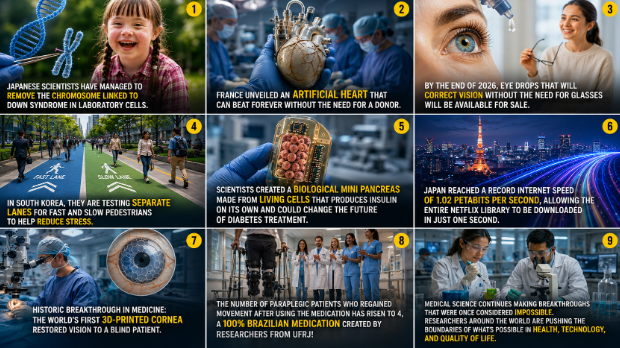
In February 2025, researchers at Mie University in Japan published a study that should have stopped every conversation in the room. Using CRISPR-Cas9 gene-editing technology, they successfully removed the extra copy of chromosome 21, the genetic cause of Down syndrome, from human cells in a laboratory setting.
The corrected cells began functioning more like typical cells, showing normalised gene expression associated with brain and nervous system development. Down syndrome affects roughly one in every 700 births globally. The work is years from clinical use, but the direction it points in is extraordinary.
2. France Built an Artificial Heart That Does Not Need a Donor
CARMAT's Aeson artificial heart, designed to replace a failing human heart without the need for a donor organ, had achieved over 100 successful implants globally by early 2026. The device is the product of more than 30 years of research and is engineered for long-term function, a permanent solution rather than a temporary bridge to transplantation.
For patients with end-stage heart failure who have no other viable option, it represents something medicine rarely delivers this cleanly: actual hope.
3. Scientists Created a Living Mini Pancreas That Produces Its Own Insulin
French researchers developed a biological mini pancreas built entirely from living cells that is capable of producing insulin independently. The implications for diabetes treatment are now significant.
Rather than managing the condition from the outside in, this approach works to restore the body's own insulin production from within, a fundamental shift in how the disease could be approached in the future.
4. The World's First 3D-Printed Cornea Has Already Restored Vision
In what would have read like science fiction a decade ago, researchers produced the world's first 3D-printed cornea and used it to restore vision in patients who had lost it.
The cornea is the transparent outer layer of the eye and one of the most transplanted tissues in the world, yet donor shortages remain a persistent challenge. Printing one from scratch changes that equation entirely.
5. Eye Drops That Could Replace Glasses Are in Development
Scientists are developing eye drops that could correct vision without the need for glasses or contact lenses. The technology is still progressing toward wider availability, but the concept is grounded in real pharmacological research, compounds that temporarily alter the eye's ability to focus.
For the 2.2 billion people globally living with some form of vision impairment, the implications of that becoming accessible are worth paying attention to.


6. Japan Recorded the Fastest Internet Speed in Human History
Although it is quite old news, in May 2025, Japan's National Institute of Information and Communications Technology, working alongside Sumitomo Electric, achieved a data transmission speed of 1.02 petabits per second, over one million gigabits every second, across a distance of 1,808 kilometres.
To put that in context: the entire Netflix library could be downloaded in under a second with that level of internet speed. The cable used is the same standard diameter already deployed in existing network infrastructure, meaning this breakthrough does not require rebuilding the world's internet from scratch.
7. Brazil Developed a Medication That Helped Paraplegic Patients Regain Movement
Researchers at the Federal University of Rio de Janeiro reported that four paraplegic patients regained movement following treatment with an experimental medication developed entirely within Brazil.
It is a 100% Brazilian innovation, the kind of story that rarely travels far beyond its own borders, which is exactly why it deserves to be named. The scale is still small. The direction is not.
8. South Korea Is Redesigning Cities Around Human Comfort
South Korea has been testing separate walking lanes for fast and slow pedestrians in busy urban areas, a deliberate, low-cost effort to reduce the low-grade daily stress of city movement. It is a small idea. It is also the kind of small idea that improves the texture of ordinary life in ways that larger announcements rarely manage.
Urban design shaped around the actual human experience of moving through a city is a more radical concept than it sounds.

None of this erases the crises that are real and ongoing. But a diet of only collapse, consumed daily without interruption, does something damaging to how people relate to the future.
People who believe nothing can be fixed stop trying to fix things. The work in these laboratories and clinics is a reminder that the world is still in the business of solving problems it once declared unsolvable, quietly, without an audience, and without waiting for permission. Pay attention to these stories too; they are the ones that will matter most.