Exclusive Crypto Insight: Knut Svanholm Declares 'Bitcoin Gives Me Hope!'
Explore the insights of Knut Svanholm, a leading Bitcoin author and educator, as he discusses his publishing venture, Lemiscate Media, and his philosophical views on Bitcoin, praxeology, and deflation. Discover his unique perspective on the cooperative nature of Bitcoin, the flaws of fiat systems, and why "fun" is integral to the journey toward a brighter, Bitcoin-centric future.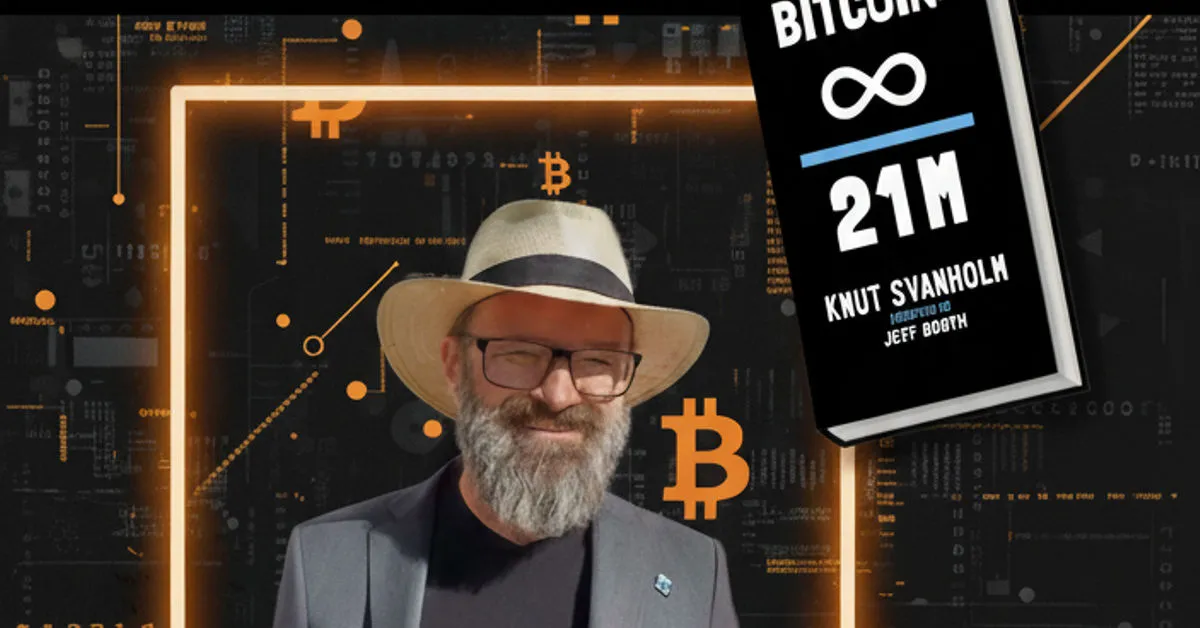
Knut Svanholm, a notable figure in the Bitcoin community, is recognized as a Swedish author, Bitcoiner, podcaster, and educator. His prolific writing and charismatic presence have earned him a reputation for Lindy-proven integrity, a quality valued in a space known for challenging established figures. Svanholm is a familiar face on the conference circuit, often identified by his distinctive voice, scruffy beard, and signature cowboy hat. His work spans uncompromising words, impressive output, and a unique, humorous demeanor.
In a recent interview, Svanholm discussed various topics including modern book publishing, the act of writing, praxeology (the foundational science of Austrian economics), spirituality, the concept of nation-states, the inherently cooperative nature of Bitcoin, and the path to a brighter, Bitcoin-centric future, emphasizing the role of "fun" in this journey. Alongside his co-author Luke de Wolf, Svanholm established Lemiscate Media, a publishing house based in Estonia. This venture allowed them to accept sats and maintain a bitcoin treasury, operating as a "bitcoin treasury company" in the traditional sense. It also provided a strategic bypass around Amazon's stringent book publishing gatekeeping, enabling all their books to be print-on-demand. All of Svanholm’s previous works, including "Everything Divided by 21 Million" and "The Inverse of Clown World," are available through Lemiscate.
When questioned about Lemiscate Media, Svanholm acknowledged a "Saifedean-like" approach, comparing himself to "Saif with a pirate hat." He clarified that this was not intentional copying but rather a natural evolution of their work, citing parallels with Saifedean Ammous's "Principles of Economics." Svanholm's book, "Praxeology: The Invisible Hand That Feeds You," was rewritten into a full course for Plan ₿, set for release. He noted his version is more accessible with shorter chapters compared to Ammous's denser text.
Reflecting on the reception of "Praxeology," Svanholm observed its limited impact compared to the massive success of "Everything Divided by 21 Million." He attributed this to a general decline in reading habits, the difficulty of following up on a major hit, and the increasing saturation of Bitcoin books in the market. His long-term aspiration is to compile all his books into a single "collected volumes" edition, potentially leatherbound. His podcast with Luke de Wolf, the Bitcoin Infinity Show, caters to "hardened Bitcoiners," focusing on "conviction-deepening" rather than "orange-pilling." Despite its serious target audience, the show incorporates humor, as Svanholm believes entertainment, whether through interest, passion, or fun, is crucial for listener engagement. He sees humor as a tool to keep people listening.
Svanholm also co-runs Satoshi Rockamoto, a series of pop-up concert events with collaborators like Mike Jarmuz, Samson Mow, and Martti Malmi. These events originated spontaneously at a Mexico conference, leading to the realization that performing at different Bitcoin conferences would be a good idea. He describes these shows as largely improvised, with a rare single rehearsal before events like BTCHel in Helsinki. Svanholm expressed surprise at being in a band with prominent figures like Martti Malmi and Samson Mow, highlighting that authenticity is a common trait among influential Bitcoiners.
A core tenet of Svanholm's philosophy is the idea that "we are our satoshis," a concept he first introduced on stage in Prague in 2023. He posits that the distinction between satoshis and personhood is blurry, emphasizing that every node and miner is backed by a person, not just energy. He defines Bitcoin as an agreement on a fixed set of rules, which are followed because breaking them is costlier than adhering to them, thus ensuring resistance, irreplicability, and finiteness. Applying economic game theory, Svanholm asserts that Bitcoin shifts the point where aggression pays, making trade inherently more attractive than raiding, as the amount of an individual's sats is unknowable. This aspect, he believes, is profoundly underappreciated.
The cooperative nature of Bitcoin is another significant theme for Svanholm. He argues that everyone in Bitcoin benefits from "number-go-up," creating an incentive for mutual assistance. Through Lemiscate Media and the Bitcoin Infinity Show, they actively practice this by providing value, confident that it will ultimately benefit them. He champions services like Vexl, a peer-to-peer trading platform, despite no direct financial incentive, because it exemplifies valuable contributions. He contrasts "fiat jobs," which are often tied to hourly wages and legal entitlements, with Bitcoin jobs, where individuals must provide value first before expecting rewards, embodying a powerful yet often misunderstood principle.
Svanholm connects this to praxeology, criticizing how the concept of "work" has been "fiat-ized" to detach it from value creation. He argues that state and labor union interventions attempt to obscure the fundamental truth that employers hire only if it's not excessively costly. He illustrates this with the example of Sweden's labor laws, which create a culture of entitlement. He explains that under a deflationary Bitcoin standard, salaries paid in satoshis would effectively increase in real purchasing power over time, eliminating the need for constant readjustments. He views micropayments and the velocity of money as Keynesian (fiat) ideas, suggesting that subscription models would gain popularity on a deflationary standard due to the incentive for companies to receive larger early payments. This is a central thesis in his book "The Inverse of Clown World," where he posits that everything true in fiat is the inverse in Bitcoin, leading to fewer but more significant and valuable transactions in a richer, deflationary society, emphasizing "quality before quantity." He envisions a future where services like coffee might be given for free, built on generations of trust.
He further delves into the relationship between trust and money, echoing the sentiment that "trust is the opposite of money." Citing Murray Rothbard's "What Has Government Done to Our Money?", Svanholm argues that money is only needed in trade when trust is absent, and credit money is not true money, as it must be denominated in something valuable. He believes that accepting a receipt without receiving the underlying valuable item is theft, which is how he views banknotes.
Touching upon his 2020 book "Independence Reimagined," Svanholm discusses collective imagination as both a human strength and weakness. He challenges the notion that natural law or property rights are invented, suggesting instead that examples of cooperation and herd behavior, even with underlying self-interest, can be observed in molecular biology and complex societies. He relates this to monetary scholars' views on money enabling large-scale cooperation beyond Dunbar's number, through shared "collective delusions" like organized religion or nation-states. However, he critiques these units, particularly nation-states and democracy, as tools for managed control that can promote destructive behaviors and swindle individuals. He has come to believe that democracy is the most dangerous religion, even more so than belief in a "fake friend in the sky," as it allows earthly individuals to exploit others under the guise of popularity contests.
Svanholm contends that economic thought was more profound before the Enlightenment when economists were also theologians grappling with questions of divine will and opposing unethical practices like interest. He credits Austrian economics with ethically explaining interest as "the price of tomorrow," noting that prices and interest rates fall in a free market. Praxeology, he explains, helps us approach deriving "an ought from an is." He cites Hans-Hermann Hoppe, stating that all human communication and interaction arise from conflict, and language serves as a tool for resolution, which leads directly to absolute property rights and argumentation ethics. He argues that the axiom of self-ownership is irrefutable, forming a sound basis for deriving further knowledge.
Despite the profound simplicity and power of these ideas, Svanholm laments their lack of mainstream appeal. He attributes this to people underestimating their own value and the pervasive influence of public education, which he asserts is funded by theft and teaches obedience and social science as mere opinions, rather than fostering value creation. He argues that public education's primary function is to promote democracy as the ultimate ideal, despite it being a system that, through popularity contests, grants the right to seize others' property, making it fundamentally flawed.
Regarding how Bitcoin can triumph, Svanholm believes that increased use of KYC-free bitcoin for transactions, free from taxes and inflation, will incrementally disarm "psychopaths." He sees this as a gradual awakening, one person at a time, evident in the clear superiority of Bitcoin over fiat money observed at conferences. He notes that the biggest hurdle to Bitcoin adoption is the significant time commitment (around 100 hours) required for self-education, which most people are unwilling to invest. Despite higher real wages and more leisure time in the West, many prefer to believe they are working for themselves, unaware that a substantial portion of their labor benefits the government and banks. He views the continued progress despite democracy, taxes, and inflation as a testament to the immense power of the free market.
Svanholm remains hopeful for the future, believing that the future lies in Bitcoin, not fiat. He sees a dichotomy: either a world of cooperation, where "eight billion people in service of eight billion people," or a descent into totalitarian oppression. Bitcoin's existence, its accessibility, and its inherent superiority make him optimistic that people will eventually embrace this better system, leading to a beautiful Bitcoin-powered world.