Economic Meltdown: Ghana's Central Bank Plunges into 'Staggering' GHS 15.6bn Loss, Sparks Outcry
Dr. Gideon Boako, Tano North MP, has severely criticized the Bank of Ghana's GHS 15.6 billion operational loss in 2025, describing it as a 'new low' and blaming politically motivated policy choices. He questioned the IMF's role and accused the BoG of wealth transfer to commercial banks through liquidity management, calling for greater transparency and accountability.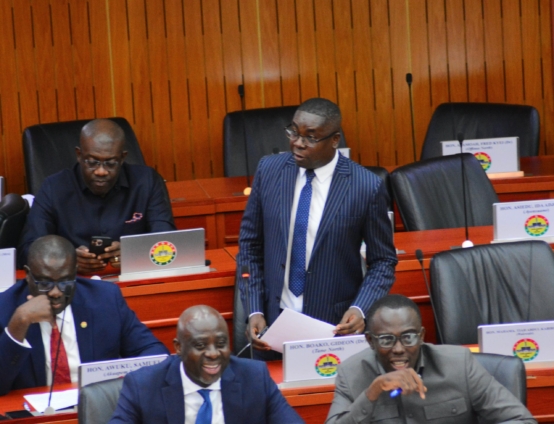
Dr. Gideon Boako, the Member of Parliament for Tano North and a member of Parliament's Finance Committee, has vehemently criticized the Bank of Ghana (BoG) for its staggering GHS 15.6 billion operational loss in 2025. Describing the loss as a "new low" and the second highest since the Cedi's redenomination in 2008, Dr. Boako expressed profound shock, especially given that 2025 was considered a non-crisis year. He had extensively analyzed the Bank's financial situation months prior and predicted its impending losses, which were confirmed in the BoG's Financial Statement released on May 1, 2026.
A significant point of concern raised by Dr. Boako is the reversal of financial progress. He highlighted that the Bank's 2024 financial statements indicated a system that was slowly healing, with operating losses narrowing from GH¢13.23 billion to GH¢9.49 billion, Other Comprehensive Income turning positive, and FX valuation losses moderating. However, the new management at the Bank of Ghana, according to Dr. Boako, reversed this inherited progress in 2025. "The most damning part? 2025 was not a crisis year. The Bank’s 2024 financial statements showed a system slowly healing... Then 2025 arrived, and the new management at the Bank of Ghana reversed the progress they inherited," he stated in an article on his Facebook page. He questioned why a central bank that had begun to recover suddenly plunged into its largest non-crisis loss in history, attributing it to "politically motivated policy choices, not stability."
Dr. Boako also questioned the efficacy and role of the International Monetary Fund (IMF) in addressing the BoG's mounting financial losses. He argued that the Bretton Woods institution failed to tackle what he termed "unsustainable quasi-fiscal operations," even though the IMF's safeguards assessments are intended to prevent "quasi-fiscal leakage." Despite these warnings and the unsustainability of the losses, the IMF continued to endorse the Bank's foreign exchange intermediation framework, leading Dr. Boako to question the IMF's credibility and whether its continued support would lead Ghana back to the IMF for an "18th time." He asserted that Ghana requires a "policy-discipline partnership" with the IMF, rather than mere "crisis-management partnership," to foster genuine economic resilience.
Further deepening his critique, Dr. Boako accused the Bank of Ghana of becoming increasingly politicized, with policy choices allegedly driven by "optics over solvency" and "narrative-management over transparency." He characterized the 2025 financial statements as "a confession" revealing a central bank that had abandoned its own recovery path. Key concerns he listed included a weakened balance sheet, a liquidity strategy that he claims subsidized commercial banks rather than stabilizing markets, and foreign exchange and gold operations that generated significant losses. He emphatically stated, "A central bank that loses GH¢36 billion in a non-crisis year, and would have lost GH¢44 billion without selling gold, cannot credibly claim that it is being attacked."
The Tano North MP specifically highlighted the Bank's liquidity management operations as a mechanism for transferring public resources to commercial banks. He noted that the BoG's Open Market Operations (OMO) costs sharply increased from GH¢8.2 billion in 2024 to GH¢16.73 billion in 2025, following the abandonment of the dynamic Cash Reserve Ratio mechanism. He labeled this move as a return to "the most expensive liquidity-management tools," even amidst declining inflationary pressures, calling it "a wealth transfer from the public balance sheet to private balance sheets," and "indefensible." Dr. Boako further alleged that the central bank reversed foreign exchange reserve-holding rules, injecting liquidity into the financial system, only to then mop it up at high interest rates through OMO instruments, thereby unnecessarily weakening its own balance sheet.
The BoG's foreign exchange and gold operations also came under intense scrutiny. Dr. Boako claimed these operations were conducted at a "structural loss," citing a GH¢9 billion loss under its gold purchase programme. He questioned why the Bank sold 18 tonnes of gold reserves yet still ended the year with substantial losses, asserting that the Bank buys foreign exchange or gold at market rates but values or sells them at an artificially lower official rate. These, he concluded, were "policy-manufactured losses" rather than unavoidable economic outcomes. He concluded his critique by calling on Ghanaians to demand greater transparency and discipline from the central bank, cautioning that the country cannot afford to treat financial credibility lightly. "Credibility, once broken, is expensive to rebuild," he warned, emphasizing the need for the BoG to answer questions rather than deflecting them.