Drone Drama: Zipline Under Fire Over Deliveries While US Pours in $150M for Expansion Across Africa!
The U.S. Government has committed up to $150 million to expand Zipline's drone-enabled medical delivery network across five African countries, aiming to reach 130 million people with essential health supplies. This initiative, part of the America First Global Health Strategy, faces scrutiny in Ghana over allegations of delivering non-essential items, sparking a debate about the service's mandate and funding allocation.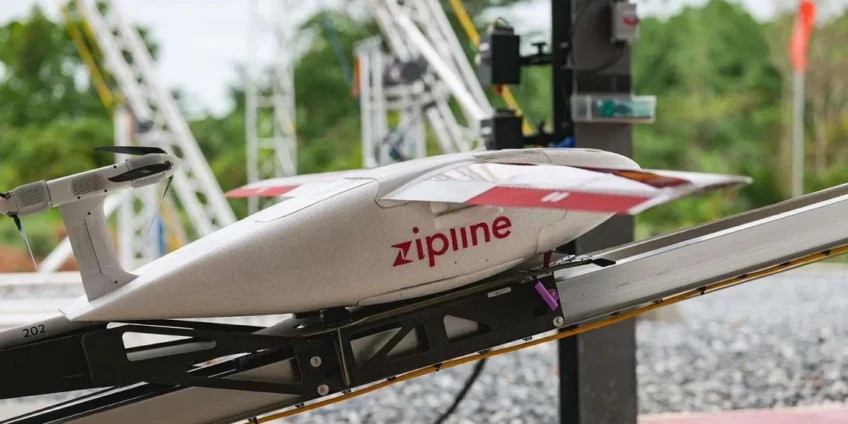
The United States Government has pledged a significant investment of up to $150 million to support Zipline International Inc., an American robotics and drone-technology firm, in scaling up its drone-enabled medical delivery operations across five African countries: Côte d’Ivoire, Ghana, Kenya, Nigeria, and Rwanda. This substantial funding aims to dramatically extend access to crucial health supplies, including blood products, vaccines, and other essential medicines, to as many as 15,000 health facilities. The announcement was made during a U.S. Embassy digital press briefing on Tuesday, December 2, 2025, and is a core component of the U.S. Department of State’s new America First Global Health Strategy. This strategy is designed to boost the value of U.S. foreign assistance by reducing waste, avoiding dependency, and aligning global health investments with U.S. policy goals.
Jeff Graham of the U.S. Department of State emphasized that partnering with Zipline is central to modernizing the U.S. approach to global health logistics. This initiative prioritizes reaching remote and underserved communities with critical health commodities. Under the agreement, U.S. support will drive the deployment of Zipline’s advanced, American-made autonomous aircraft to overcome slow and unreliable delivery systems that have historically hindered timely access to medical supplies. Graham described this investment as a significant step toward strengthening health systems’ capacity to respond swiftly to disease outbreaks and medical emergencies, while also supporting U.S. manufacturing and creating jobs across partner countries.
The investment is projected to spur massive growth in Zipline’s operational footprint, with new distribution centers opening across the participating countries. Rwanda, for example, is expected to double its daily delivery capacity, enabling the network to eventually serve up to 130 million people across Africa. This national-scale rollout is anticipated to generate significant economic returns, including the creation of an estimated 1,000 jobs and more than $1 billion in annual economic gains across the partner nations. The expansion is also supported by partners such as the Elton John AIDS Foundation.
Caitlin Burton, CEO of Zipline Africa, explained that the company’s autonomous, all-weather drones already operate around the clock to maintain a responsive, on-demand medical supply chain, often outperforming traditional logistics systems. She noted that Zipline’s mission extends beyond mere logistics, aiming to equip health systems to end preventable deaths, from HIV transmission to maternal mortality and severe malnutrition. “This system is meant to operate nationwide and at a scale that truly changes health outcomes,” Burton explained, asserting that the network is built to meet goals like solving challenges in maternal mortality and malnutrition.
Regarding the sustainability model, Graham stressed that while the U.S. provides initial capital, partner governments will ultimately assume full operational responsibility for their national health delivery networks. Burton added that this model allows countries to replace multiple expensive, disease-specific programs with one unified national delivery infrastructure that tackles various health challenges simultaneously. She stressed that governments will cover the fixed and predictable long-term operating costs, ensuring essential medical products reach patients everywhere, including communities where distance or stigma might prevent people from seeking care. The government investment level, she clarified, will reflect national priorities and their commitment to building responsive, agile, and resilient health systems.
Despite this significant international backing, Zipline’s operations in Ghana have recently faced intense scrutiny. Health Minister Kwabena Mintah Akandoh alleged during the Government Accountability Series on Monday, December 1, 2025, that the drone program was being misused to transport non-essential items such as condoms and textbooks, claiming the multi-million-dollar service had veered off its original purpose of delivering emergency, life-saving medical supplies to hard-to-reach communities.
In response, Daniel Kwaku Merki, Country Manager of Zipline Ghana, strongly defended the integrity of its drone delivery operations. Speaking on Adom TV Badwam, he insisted that the service remains focused on emergency, life-saving medical supplies and has already saved “over 10,000 lives.” Merki clarified that Zipline plays no role in determining what items are dispatched, emphasizing that every request originates from the appropriate health agencies under the Ministry of Health. “Critical life-saving commodities, which we have delivered, have saved lives in the tune of 10,000,” he stated, adding, “There is a list we work with from the Ministry of Health, of products we are mandated to deliver.”
Addressing concerns about non-medical items, Mr. Merki maintained that such deliveries are “extremely rare,” accounting for roughly one in every 20,000 flights. He further clarified that these items are never delivered as standalone packages but are always included as part of broader medical supply requests. For instance, “These condoms were not a box of condoms delivered by itself. It was added in association with other commodities.” Zipline’s response underscores its position that the drone delivery program remains a vital emergency healthcare lifeline, especially for remote and underserved communities where access to essential medical supplies can make the difference between life and death.
Further intensifying the debate, Professor Titus Beyuo, MP for Lambussie, launched a critique on Channel One on Tuesday, December 2, 2025, arguing that the substantial investment in Ghana’s Zipline drone delivery service should be immediately redirected to shore up the country’s struggling local blood bank infrastructure. Leveraging his insights into public health logistics, Prof. Beyuo contended that funds allocated to Zipline could be strategically used by the National Blood Service (NBS) to establish and equip blood storage facilities across all 261 districts, ensuring instant local access to life-saving blood and cutting down on transit time and costs.
Prof. Beyuo criticized Zipline for moving beyond its core purpose of emergency deliveries for critical items like blood and anti-venom, arguing that the routine distribution of non-critical items should be handled through Ghana’s existing public health supply chain logistics. He noted that Minister Akandoh had confirmed Zipline’s transport of a broad spectrum of non-emergency products, including contraceptives (condoms), preventative items (mosquito nets), administrative supplies (blood-donor cards), nutrition (food and nutrition supplies), consumables (syringes and needles), and educational materials (textbooks and uniforms). This confirmation, according to Prof. Beyuo, suggests Zipline is functioning more as a general logistics contractor than a dedicated emergency response service, thus justifying his insistence on redirecting funds toward building permanent, local health infrastructure.