Manchester United’s Maguire Handball Goal Stood. Here’s Why
A controversial handball incident involving Harry Maguire's disallowed goal against Ipswich Town has reignited debates over football's complex rules. Despite the ball coming off Maguire's arm, VAR awarded the goal due to it being an own goal, leveraging a specific exemption in the handball law. This decision drew mixed reactions from managers and pundits, highlighting the rule's ongoing confusion.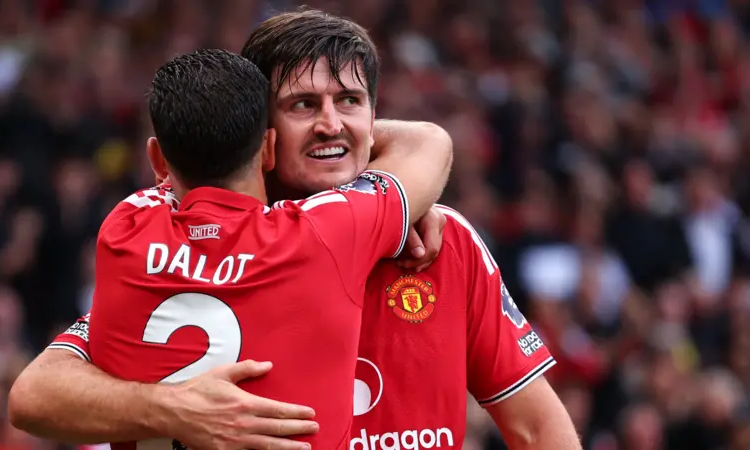
Harry Maguire appeared to handle the ball. A few seconds later, Manchester United were celebrating a goal.
For anyone watching Manchester United's 5-2 win over Ipswich Town on Sunday, the sequence looked simple enough. The ball hit Maguire's hand, he moved forward and shot, and the ball ended up in the net.
So why wasn't the goal ruled out?
Because Maguire didn't actually score it.
His shot was heading wide before it hit Ipswich defender Jacob Greaves and went into the net. The goal was therefore recorded as a Greaves own goal, and that technical detail became the reason VAR allowed it to stand.
The Premier League's own VAR explanation confirmed that Maguire's handball was considered accidental and that he was not the immediate goalscorer.
It sounds strange because, well, it is.
The Handball Wasn't Enough to Cancel the Goal
There is a rule that says a goal cannot stand if an attacking player scores directly with their hand or arm, even if the contact was accidental. The same applies when the player scores immediately after the ball touches their hand or arm.
But that wasn't what happened at Old Trafford.
Under Law 12 of the Laws of the Game, not every contact between the ball and a player's hand or arm is automatically a handball offence. The Premier League's handball guidance also explains that when an attacking player is involved in an accidental handball, the goal is not automatically cancelled if the ball does not go directly into the net and a defender subsequently turns it into an own goal.
That is essentially what happened here.

Maguire's shot was going wide. Greaves got a touch on it, and that touch sent the ball into his own net.
VAR Jarred Gillett therefore told referee Craig Pawson that the accidental handball was not punishable and recommended that the goal be awarded.
Had VAR judged Maguire's contact with the ball to be deliberate, the situation could have been different.
Why It Feels So Wrong to Fans
This is the part that has caused the argument.
From a spectator's point of view, Maguire's hand clearly became part of the attacking move. He handled the ball, carried on, took the shot and created the situation that ended with United going 2-1 ahead.
The fact that Greaves got the final touch can therefore feel like a technical escape.
But football's laws don't work entirely on what feels fair in the moment. They depend on specific conditions being met.
And in this case, the distinction was between Maguire being involved in the build-up and Maguire actually being the player who scored.

That's why a goal that looked like it should be disallowed at first glance ended up counting.
It isn't even the first time football has produced something similar. A comparable incident happened during Brentford's match against Liverpool in 2023, when an accidental touch off Ben Mee's arm eventually resulted in an own goal after the ball deflected off Ibrahima Konate.
United Didn't Need the Goal to Win
The handball debate might have dominated the conversation afterwards, but it wasn't what won Manchester United the game.
United came from behind to beat Ipswich 5-2, with Bruno Fernandes scoring a hat-trick. Bryan Mbeumo also got on the scoresheet, while Chuba Akpom scored a late consolation for Ipswich.
That matters because the controversial goal did not decide the match on its own.
Still, it gave United the lead and changed the momentum of the game.
For Ipswich, that is probably what makes the decision harder to swallow. Even if the rule was correctly applied, the goal came at a crucial point when the match was still close.
And that is why this incident has become bigger than one goal.
The officials may have followed the law as it is written. The debate now is whether the law itself makes sense when an attacker can handle the ball, shoot, have a defender provide the final touch and still see the goal awarded.
Football has spent years changing its handball rules to make decisions clearer.
On Sunday, it produced another one that left almost everyone asking for an explanation.