China's AI Embrace: A Global Blueprint for Future Tech Use
China is rapidly embracing artificial intelligence, with hundreds of millions of citizens and businesses integrating AI tools like OpenClaw into daily life and operations. Despite U.S. export controls on advanced chips, the nation is quickly narrowing the performance gap with U.S. models, positioning itself as a burgeoning AI innovator.The embrace of artificial intelligence (AI) in China has reached unprecedented levels, transforming daily life and business operations across the nation.
A striking demonstration of this enthusiasm was recently observed in Beijing, where approximately 50 individuals queued outside the headquarters of a Chinese mobile internet company, eager for assistance in installing an AI assistant.
This scene, featuring engineers helping crowds set up the popular AI "agent" OpenClaw on their laptops, was not isolated, being replicated for days at various events in Beijing and in Shenzhen, a southern technology hub, back in March.
A Nation Racing Not to Fall Behind
This rapid adoption stems from a societal concern about technological advancement.
Sun Lei, a 41-year-old human resources manager, articulated this sentiment, stating her worry about "falling behind in technological developments" and her hope that AI tools could streamline processes like sourcing and screening resumes across multiple recruitment platforms.
More than a year after OpenAI's Chinese competitor DeepSeek unveiled its advanced AI model, China has evolved into a massive testing ground for AI tools, seeing widespread adoption even as U.S.-built AI models retain dominance in raw computing power.
The swift and pervasive integration of AI into nearly every facet of life is evident, with ordinary Chinese citizens leveraging the technology for diverse tasks ranging from booking travel and planning itineraries to ordering food and hailing rides.
By December, over 600 million of China's 1.4 billion population were using generative AI, marking a remarkable 142% increase from the previous year, according to the China Internet Network Information Center.
The surge in the use of "agentic" AI, exemplified by OpenClaw, has fueled a significant increase in data consumption by AI models.
OpenRouter, an AI "gateway platform" monitoring data and security across various AI models, reported that the weekly share of data tokens used by Chinese AI models recently surpassed that of U.S. models.
This trend underscores China's influence in the global AI landscape.
Individuals like Jason Tong, a 64-year-old retired IT engineer in Shanghai, embody this pervasive integration.
Having used AI chatbots such asDoubao and Kimi for everyday queries for years, Tong recently joined a blood glucose monitoring service that uses an AI model to provide tailored health advice, finding its personalized and rapid responses exceptionally helpful.
Tong firmly believes that the widespread adoption of AI applications in daily life is "inevitable," likening it to the historical transition from carriages to trains.
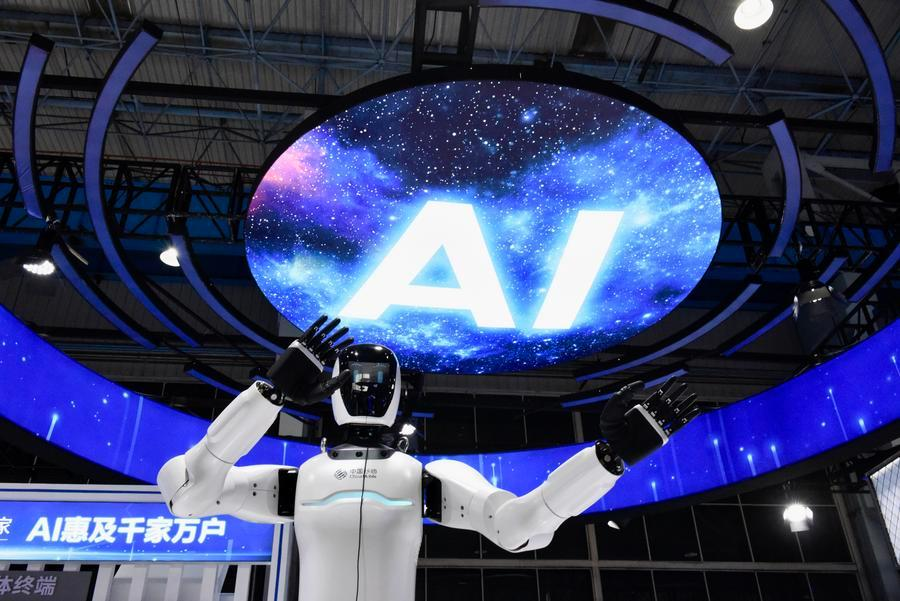
Chinese products incorporating AI are making substantial strides, from humanoid robots with advanced cognitive capabilities to AI systems that assist drivers with complex tasks like making restaurant reservations.
Lizzi Lee, a fellow at the Asia Society Policy Institute's Center for China Analysis, notes that the "AI competition is clearly shifting from models to ecosystems," emphasizing that "Chinese users are basically acting as real-time testers at scale."
From Everyday Convenience to a Full-Scale AI Ecosystem
Major Chinese technology companies, including Tencent, Alibaba, and Baidu, are vigorously pursuing the commercialization of AI.
Tencent has integrated OpenClaw into WeChat, its "super-app" used for messaging, food ordering, and payments, while Alibaba is embedding "agentic" AI into its internal workflows.
OpenClaw itself, initially developed by Austrian software developer Peter Steinberger last year, quickly gained traction due to its remarkable ability to utilize various tools to accomplish intricate tasks.

Zhao Yikang, a Chinese college student in Macao, leverages OpenClaw for both academic pursuits and daily life, praising its cost-effectiveness and efficiency. He used it during an internship at a real estate agency in Zhuhai to automatically generate promotional videos and manage social media accounts.
Preparing to launch a photo services business, Zhao successfully used AI to build a fully functional company website within 10 minutes for less than 5 yuan (70 cents), noting, "AI can understand things in a second. You just need to act as a commander and tell it what to do."
Despite initial warnings from Chinese authorities regarding potential security risks, such as data leaks associated with the spike in OpenClaw installations, public interest has remained strong.
Businesses in China are increasingly setting internal targets to boost AI usage for improved efficiency, as observed by Janet Tang, a partner & managing director at AlixPartners.
Wang Xiaogang, co-founder of SenseTime, highlights the "lot of application scenarios" and the eager, open attitude of the Chinese people to try AI.
The government's commitment to AI is encapsulated in its "AI plus" national blueprint, which outlines strategies for integrating AI across various life sectors, including healthcare and education.
This commitment is supported by a pledge for an annual average growth of at least 7% in nationwide R&D spending until 2030. Practical applications are already visible, with judges in Shenzhen processing 50% more cases last year, partly due to AI tools assisting judicial processes.
Ambition Meets Resistance: Chips, Competition, and the Global AI Race
However, China's AI ambitions face a significant bottleneck. There is limited access to the world's most advanced computer chips due to U.S. restrictions.

Samm Sacks, a senior fellow at New America focusing on Chinese technology policies, describes these export controls as the "Achilles' heel of many AI labs that need advanced AI chips."
Yet, Sacks also points out that these controls have inadvertently led to enhanced coordination in design, manufacturing, and adoption across China’s tech supply chain, a dynamic that "could fuel, not foil, China’s ambitions" over time.
This dynamic is already evident as China progresses towards becoming an AI innovator. Last month, when China's DeepSeek released its highly anticipatedV4 AI model preview, a notable development was its partial support by computer chips made by Chinese tech giant Huawei, signifying reduced dependence on top U.S. chipmakers like Nvidia.
A recent report from Stanford University’s Institute for Human-Centered AI confirmed that the "U.S.-China gap in top AI models’ performance has effectively closed."
While U.S. policymakers and AI firms have accused Chinese AI startups of intellectual property theft, allegations China denies, analysts like Lian Jye Su of Omdia believe the AI gap will continue to narrow despite U.S. export controls and China's Great Firewall.
Su suggests that hurdles like the Great Firewall will likely have limited impact on China’s AI use, given that the technology is already being tested, integrated, and scaled up within China’s controlled internet environment.
He predicts, "It won’t be long before China moves from fast follower to parallel innovator."