Celestial Spectacle: Europe Prepares for Rare Total Solar Eclipse
On August 12, 2026, a spectacular total solar eclipse will sweep across parts of Greenland, Iceland, and northern Spain, captivating millions. Western Europe, including the UK, will witness a significant partial eclipse. This rare astronomical event promises daytime darkness, temperature drops, and a unique celestial spectacle for those observing safely with certified equipment.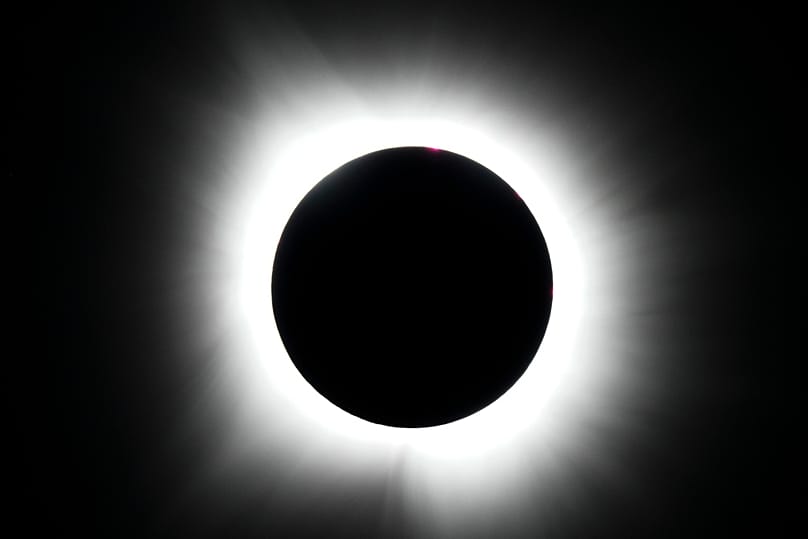
On Wednesday, August 12, 2026, a spectacular solar eclipse will captivate onlookers across a narrow swathe of the planet, following a previous event observed on Easter Island in October 2024. This upcoming astronomical phenomenon will see the Moon pass perfectly between the Sun and Earth, casting its shadow, or umbra, across various regions. Parts of Greenland, Iceland, and northern Spain are poised to experience a total eclipse, while millions across Western Europe will witness a significant partial eclipse.
The Moon's sun-blocking shadow will race along an 8,260-kilometer course, predominantly over the empty Atlantic Ocean, taking approximately 1.5 hours. Starting near the North Pole, around Siberia in Russia, before tracking south, the period of totality is expected to last up to 2 minutes and 18 seconds. Daytime darkness will descend upon the Iberian Peninsula, as well as slivers of Greenland and Iceland. In the United Kingdom, observers are particularly fortunate, with more than 90% of the Sun expected to be covered by the Moon for most regions, described as a "golden hour eclipse" occurring low on the western horizon around sunset. The historic Royal Observatory Greenwich in London plans to host a watch party, live-streaming the event from its terraces, weather permitting.
An eclipse occurs when a new moon passes exactly between our planet and the sun. This rare alignment is made possible by a remarkable cosmic coincidence: although the Sun is 400 times larger than the Moon, it is also approximately 400 times farther away from Earth, causing both celestial bodies to appear roughly the same size in our sky. This unique alignment allows the Moon to almost completely obscure the Sun's light. The area where the Moon casts a total shadow is known as the umbra, while the region experiencing a partial blockage of the Sun's light, leading to a partial eclipse, is termed the penumbra.
Witnessing such an event from the very same location can be a rare occurrence; a total solar eclipse might only be visible again after more than 200 years. For Spain, the last full solar eclipse, excluding the Canary Islands, occurred over a century ago in 1912. The maximum totality for the 2026 eclipse will be observed off Iceland’s west coast, gradually diminishing to about a minute or so by the time it reaches a small patch of Portugal and then Spain, concluding its spectacle over the Mediterranean Sea.
The experience of a total solar eclipse is profound, characterized by daytime darkness, a noticeable drop in temperature, and an eerie silence as animals and birds confuse the moment with nighttime. However, safety is paramount for direct viewing. Staring at the Sun, even when a mere sliver of light remains, can cause permanent eye damage. Experts, such as Jake Foster, an astronomer at the Royal Observatory Greenwich, strongly advise the use of ISO-certified solar eclipse glasses. These specialized glasses block out 99.9999% of the Sun's light, making it safe to view the phenomenon directly.
Despite the predictability of these celestial events centuries into the future, solar eclipses remain a source of immense excitement for both the scientific community and millions worldwide. Astronomy shops across Europe are experiencing a last-minute rush for certified viewing equipment; in Paris, customers queued for over two hours to acquire eclipse glasses and binoculars. Simon Noé, a video game researcher, expressed his childhood anticipation, stating, "2026 seemed so far away. So this is a bit about making my inner child happy." The European Space Agency (ESA) also plans to observe the eclipsed sun and its corona, or outer atmosphere, with two of its space telescopes, including the Proba-3 satellite duo, which will attempt to capture before-and-after shots.
Jake Foster encapsulates the universal appeal, noting that solar eclipses are "incredibly exciting, even if you've seen a few of them. It really is a bucket list event, and there's really no limit to the amount of times you can see a bucket list event." The August 2026 eclipse promises to be an unforgettable spectacle, uniting scientific curiosity with widespread public wonder.