Book Smart vs Street Smart: What Kind of Intelligence Does the African School System Value?
This thought-provoking article questions the narrow definition of intelligence in African schools. It explores how academic brilliance often overshadows practical, street-smart skills and why it is time to rethink what we truly value in our students.
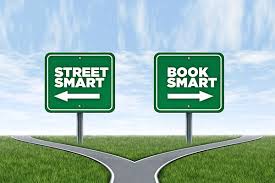
Let's take a look at a hypothetical situation: There is a girl in secondary school who can recite almost all the botanical names of plants correctly. Her notebooks were neat, and her hand always shot up before the teacher finished a question. But if you dropped her two streets away from school, she would panic. She can't hail a bus without help or bargain for lunch at the roadside kiosk.
In the same class, there is David, the boy who barely passed tests but always found a way to convince the Chemistry teacher to shift the deadline. He couldn’t explain the periodic table, but he could fix a broken fan with scrap parts and knew exactly how to talk his way out of trouble with senior prefects.
Now, who is smarter? Everyone would be quick to point their fingers at the girl because of her academic abilities, but they are both smart — smart on different pedestals. She is book smart, and he is street smart.
In most African schools, the system is wired to recognize academic performance as the only valid form of intelligence. If you can memorize, write fast, and align your answers with the teacher’s marking scheme, you are a genius. If you can’t, then sorry, you are not “serious.”
But life outside the classroom has its own rules, and unfortunately, most students only realize this when they leave school with first-class degrees and zero survival skills.
The Cult of the “Crammer”
From nursery rhymes to university defense panels, students are groomed to chase academic perfection at the expense of everything else. The African classroom is a performance stage, where remembering is more important than understanding.
If you ask too many “why” questions, you are either stubborn or wasting time. The goal is clear: pass the exams, get the certificate, and move on.
In countries like Nigeria, where WAEC and JAMB serve as educational gatekeepers, exams are designed less to test intelligence and more to assess memory retention. Past question booklets are passed around, and students learn to master the art of cramming and not critical thinking.
The tragedy is that those who can’t play by these rules are cast aside. Their value is measured by low grades, despite possessing a different, often more versatile type of intelligence.
Photo Credit: Safety4Sea
Street Smart is Not Street Foolish
Being “street smart” is often misunderstood in African academic spaces. It is not about skipping class or being a “yahoo boy.” It is about having emotional intelligence, strategic thinking, adaptability, and survival instincts. It is the kind of intelligence that doesn’t show up in written exams but is deeply valuable in real-world settings.
Think of the students who can run a small business from their hostel, who organize events or protests with nothing but WhatsApp groups and voice notes. Think of the girl who sells thrift clothes online and the guy who manages artists while studying law. These students may not get first-class degrees, but they are acquiring life skills schools don't teach.
Social Insight
Navigate the Rhythms of African Communities
Bold Conversations. Real Impact. True Narratives.
Still, in most African classrooms, they’re invisible. And worse? They are mocked.
Who Decides What Counts as Intelligence?
The African school system has a narrow definition of intelligence. Subjects like Mathematics, Physics, and English are placed on pedestals, while artistic, social, or entrepreneurial talents are treated as “less serious.” A student who doodles or writes poetry is expected to keep it as a hobby, not a path.
This mindset is rooted in colonial-era education, where schools were designed to produce obedient civil servants, not thinkers and inventors. Today, the legacy remains: if your intelligence doesn’t come with good grades and certificates, it is not considered “real.”
This is despite evidence from psychologists like Howard Gardner, who proposed multiple intelligences — from logical reasoning to interpersonal skills to kinesthetic abilities. But until African classrooms begin to reflect this diversity, students will continue to feel boxed into roles they were never meant to play.

The Cost of One-Dimensional Schooling
When school becomes a competition of who can memorize the fastest, we lose more than just creativity; we lose students.
Many young people who don’t thrive academically internalize the belief that they are unintelligent. They carry this into adulthood, where impostor syndrome, self-doubt, and underemployment become constant battles.
Meanwhile, some of the most successful African entrepreneurs, artists, and content creators often confess to being average or struggling students.
What the school system failed to see, life eventually rewarded.

Photo Credit: TheCBSPost
Rethinking What We Teach — and How
Don't be mistaken, academics matter. Literacy, numeracy, and theoretical knowledge are important. But they shouldn’t be the only measures of worth.
African schools need to create space for practical learning, emotional intelligence, and entrepreneurial thinking. Students should be allowed to explore their strengths without shame. A boy who can fix electronics should be just as celebrated as a girl who excels in Chemistry. A student who leads a community project deserves as much recognition as the best debater.
Education should be holistic, not hierarchical. Intelligence isn’t boxed, nor is success. So, why should we?
Social Insight
Navigate the Rhythms of African Communities
Bold Conversations. Real Impact. True Narratives.
Intelligence Beyond the Classroom
One of the greatest ironies of African society is how many parents still measure success by the number of degrees their children collect, yet praise those same children when they find “smart” ways to survive outside school.
The same aunties who mocked “lazy art students” now repost their TikToks. The same uncles who wanted engineers and doctors now quote life advice from comedians.
The truth is the world has changed, and intelligence now wears many outfits — some with lab coats, others with ring lights and Canva templates. The earlier we embrace this shift, the more equipped our students will be to face life with confidence.
Final Grades
The African school system needs a makeover — one that acknowledges intelligence as a spectrum, not a statistic. It must stop forcing students into binary boxes of book smart or nothing.
We need classrooms that foster curiosity, not conformity. Learning should be a dialogue, not a dictatorship.
Until then, students like David — the resourceful, charismatic ones — will continue to slip through the cracks, their brilliance hidden behind red ink and low grades.
And maybe, just maybe, it is time we start handing out awards for street smarts, too.