Anthropic Is Watermarking Claude's Text. What Happens When AI Writing Becomes Traceable?
Anthropic is adding invisible watermarks to Claude-generated text worldwide. The move could reshape how businesses, creatives and organisations identify AI-assisted content and determine authorship.
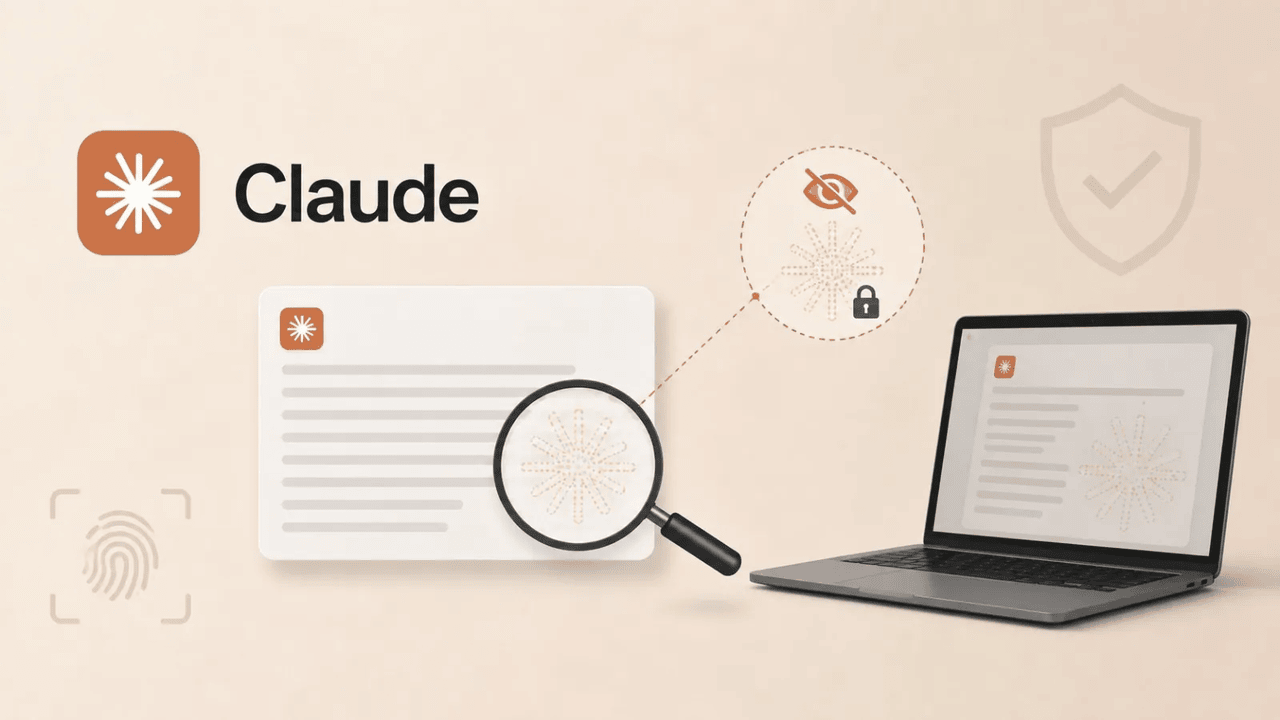
Anthropic has begun adding invisible watermarks to text generated by newer Claude models, introducing another layer to the increasingly complicated relationship between artificial intelligence and the content it produces.
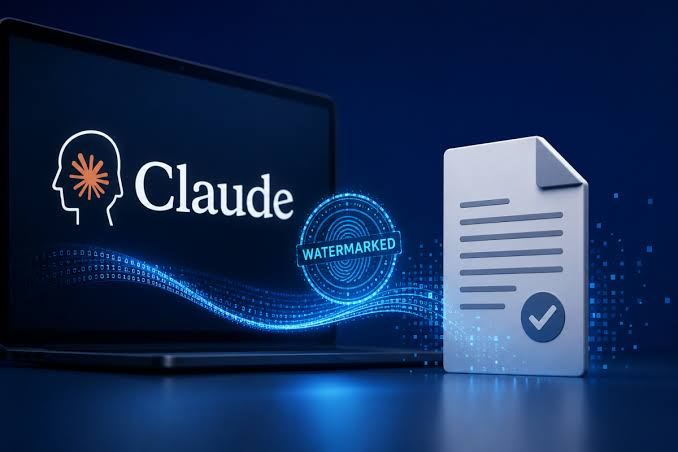
The company says Claude models launched from August 2 will carry an imperceptible signal at the model level. The watermark does not alter the meaning or readability of the text, and it remains attached when the text is copied and pasted, although Anthropic says it may survive only some forms of editing.
The decision is part of Anthropic's effort to comply with the European Union's AI Act and its Code of Practice on AI-generated content. But the company has chosen to apply the system worldwide rather than limit it to European users.
That makes the development more significant than a regulatory compliance exercise. It could change how businesses, creatives, publishers and organisations think about AI-generated content.
What the Watermark Actually Means
The watermark will apply across Claude's ecosystem, including the Claude app, API, Claude Code, Claude Cowork and Claude Tag. Customers accessing supported models through Amazon Web Services, Google Cloud and Microsoft Foundry will also receive marked output.
Anthropic is taking a different approach with files. Supported formats, including common image types, will carry signed provenance metadata based on the Coalition for Content Provenance and Authenticity, or C2PA, standard rather than an embedded text watermark.
The system is not, however, an invisible lie detector for AI writing. Anthropic acknowledges that heavy editing, paraphrasing, translation, or combining Claude's output with human writing can make the watermark undetectable.
More importantly, detecting a watermark does not necessarily prove that Claude originally wrote the material. Someone could use Claude to proofread, translate, or modify text that was originally written by a human.
The explanation above matters because the watermark identifies an interaction with the model, not necessarily the complete origin of a piece of writing.
Older Claude models will not immediately carry the marking system, although Anthropic says it is working to extend the capability during the EU AI Act's transition period. The company also plans to publish technical information to help users and third parties detect the marks.
What It Means for Businesses, Creatives and Organisations
For businesses that increasingly depend on AI for marketing, customer communication, research, software development and internal documentation, provenance could become another part of the content workflow.
A company using Claude to draft a press release, generate marketing copy or prepare a report may eventually have to think about whether that material carries an AI provenance signal. That does not automatically make the content less valuable, but it could change how organisations document the way their content was produced.
For creatives, the implications are even more complicated. A writer could use Claude to brainstorm an idea, rewrite a paragraph or correct grammar without asking the model to create the entire piece. If a watermark survives that process, does its presence mean the final work should be classified as AI-generated? Anthropic itself says no.
That is precisely why detection cannot be treated as definitive proof of authorship. The bigger challenge may therefore be institutional.
Schools, publishers, employers and media organisations that use AI detection systems will have to distinguish between AI assistance and AI authorship. A watermark may provide evidence that AI was involved, but it cannot automatically explain how much AI was involved or what role it played. That could make content policies more complicated rather than simpler.
What Nobody Is Really Talking About
The most interesting consequence of AI watermarking may not be whether people can detect Claude's writing. It may be who gets to decide what that detection means.
As AI becomes embedded in ordinary work, the boundary between human-created and AI-assisted content is becoming increasingly difficult to define. A journalist may use AI to organise research. A designer may use it to generate an initial concept. A company may use it to translate customer communications. A writer may use it to improve grammar.
All of these activities involve AI, but they are not equivalent. That is where watermarking could become controversial. If organisations begin treating the presence of an AI watermark as evidence that content is fundamentally AI-generated, the technology could create new forms of suspicion around legitimate human work.

There is also a larger question about trust. Watermarking works only as well as its detection system, its resilience to manipulation, and the willingness of institutions to interpret the signal correctly. Anthropic has already acknowledged that sufficiently heavy editing can make the mark disappear.
Google DeepMind has taken a similar direction, having announced text and video watermarking through SynthID for Gemini in 2024 after introducing image watermarking the previous year.
The direction is becoming clear. AI companies are not simply building systems that generate content anymore. They are beginning to build systems that leave behind evidence of how that content came into existence.
That could eventually become normal, but if AI provenance becomes part of the digital world's infrastructure, the real debate will not be whether a machine touched a piece of content. It will be whether we become sophisticated enough to understand how much that touch actually mattered.